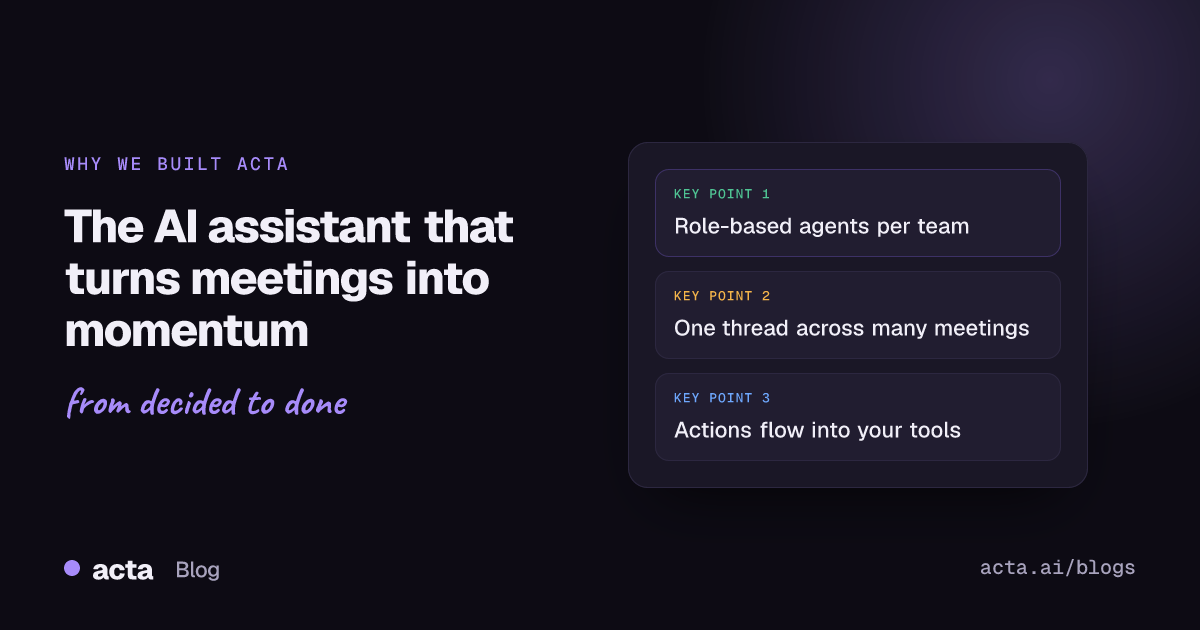
Quick answer: Acta is an AI meeting assistant built so that every meeting ends with clear actions, accountability and progress. Its role-based AI agents understand the context of a conversation and turn it into PRDs, Jira tickets, sales follow-ups and interview notes, connect related meetings into one thread you can question, and push the results into tools your team already uses.
We have all been there: endless meetings, overflowing notes and that sinking feeling that nothing really moved forward. That frustration is why we created Acta, an AI meeting assistant built to make meetings meaningful again.
Why did we build Acta?
Before starting Acta, I spent years in the corporate world going from one meeting to the next. Every meeting needed minutes, summaries and follow-ups, and all of it was done by hand. It was slow, repetitive and, honestly, exhausting.
That experience taught me something simple:
Meetings are supposed to create momentum, not more work.
So the idea for Acta was a way to make every meeting end with clear actions, accountability and measurable progress. Even the name comes from the Latin word for "official records or proceedings", because that is what we wanted to build: a tool that does not just listen to meetings but turns them into structured, useful records and outcomes.
What exactly is Acta?
Acta is an AI meeting assistant that goes well beyond note-taking or transcription. Instead of only recording what was said, Acta's persona-based AI agents understand the context of a conversation: who is talking, what their role is and what needs to happen next.
These agents can produce:
- Product requirement documents (PRDs)
- Jira tickets
- Sales reports and follow-ups
- Interview notes and candidate assessments
- Technical breakdowns for engineering teams
Each output is tailored to the department's workflow, from sales and product management to HR and engineering.
How does Acta connect multiple meetings?
One of my favorite things about Acta is that it can bring multiple meetings together in a single thread.
Most projects are not decided in one meeting. They evolve over weeks of discussion. Acta connects those related meetings and gives you one view of the decisions, tasks and progress along the way, and it can turn them into a consolidated report.
You can simply ask, "What did we decide about the product launch last month?" and OneChat answers with the full story across every related meeting, with sources. It is like having an AI chief of staff who never forgets anything. We explain how this works in how to ask questions across every meeting you have had.
How does Acta fit into existing tools?
Acta does not ask you to change how you work. It connects to Jira, Salesforce, HubSpot, Zoho, Notion and Google Drive, so when something is decided in a meeting:
- "Create a ticket" becomes a Jira task
- "Follow up with the client" is captured in Salesforce or your CRM
- "Let's document this" goes straight into Notion or Google Drive
The result: fewer lost action items and forgotten decisions, and follow-through that happens without someone chasing it.
How does Acta handle privacy and security?
We take privacy seriously. Meeting conversations hold a company's most sensitive information: ideas, strategy and intellectual property. That is why Acta was built with security at its core, not added as an afterthought.
- Your meeting data belongs to you.
- People only see the meetings they have access to.
- We do not use customer data to train our AI models.
In short: your data stays yours.
Built in India, trusted globally
Building an enterprise-grade AI product in India came with challenges, especially earning global trust. But that is also what shaped Acta. We designed for privacy by default, security by design and a global mindset from day one, and today Acta serves teams across India, the US and Europe. You can read more about that journey in Make in India, Made for the World.
How has Acta grown?
Within about six months of launching the SaaS version, Acta had passed 15,000 active users, and most of that growth was organic, driven by referrals and word of mouth. The next phase is about expanding enterprise adoption, including in regulated sectors such as banking, financial services and healthcare.
Who is Acta for?
Our goal is to make AI productivity accessible to everyone, from solo professionals to large enterprises. Plans scale from individuals to custom enterprise agreements, and you can see current options on the pricing page or start with a free 15-day trial.
What comes next for Acta?
We want Acta to grow from meeting intelligence into organizational intelligence. Areas we are working toward include:
- Meeting efficiency analytics: measuring how meetings affect productivity and decisions
- Sentiment and engagement insights: helping leaders understand team dynamics
- Deeper workflow automation: more of the follow-through handled across tools
- Custom AI agents: tailored to an organization's own workflows
Our vision is simple: make Acta the command center for collaboration, where every conversation creates real progress.
At its heart, Acta is about giving teams back their most precious resource, time. By turning conversations into actions, it lets people spend less effort remembering what happened and more on building what comes next. Meetings should not end with minutes. They should end with momentum.
Frequently asked questions
What does the name Acta mean?
Acta comes from the Latin word for official records or proceedings, reflecting the goal of turning meetings into structured, useful records and outcomes.
Can Acta combine several meetings into one view?
Yes. Acta can bring related meetings together, produce consolidated reports and answer questions across them with OneChat, citing the meetings it used.
Which tools does Acta integrate with?
Acta integrates with Jira and other ticketing tools, Confluence, Notion, Google Drive, Salesforce, HubSpot and Zoho.
Does Acta use my meetings to train AI models?
No. Customer data is not used to train Acta's AI models, and people only see the meetings they have access to.