Quick answer: To align AI initiatives with business strategy, start with clear objectives, then map AI to high-value, real-world problems rather than deploying it as a standalone tool. Embed it in the workflows and systems people already use, measure its impact on outcomes such as productivity and follow-through, and build in privacy and security from the start so the value lasts.
Artificial intelligence has moved from experiment to strategic driver of value in the enterprise. Yet AI only delivers lasting impact when it is tied closely to organizational goals and business outcomes, not when it is deployed as a standalone tool or a trendy add-on. Here are the lessons we have learned building Acta.
Why should business objectives come before AI implementation?
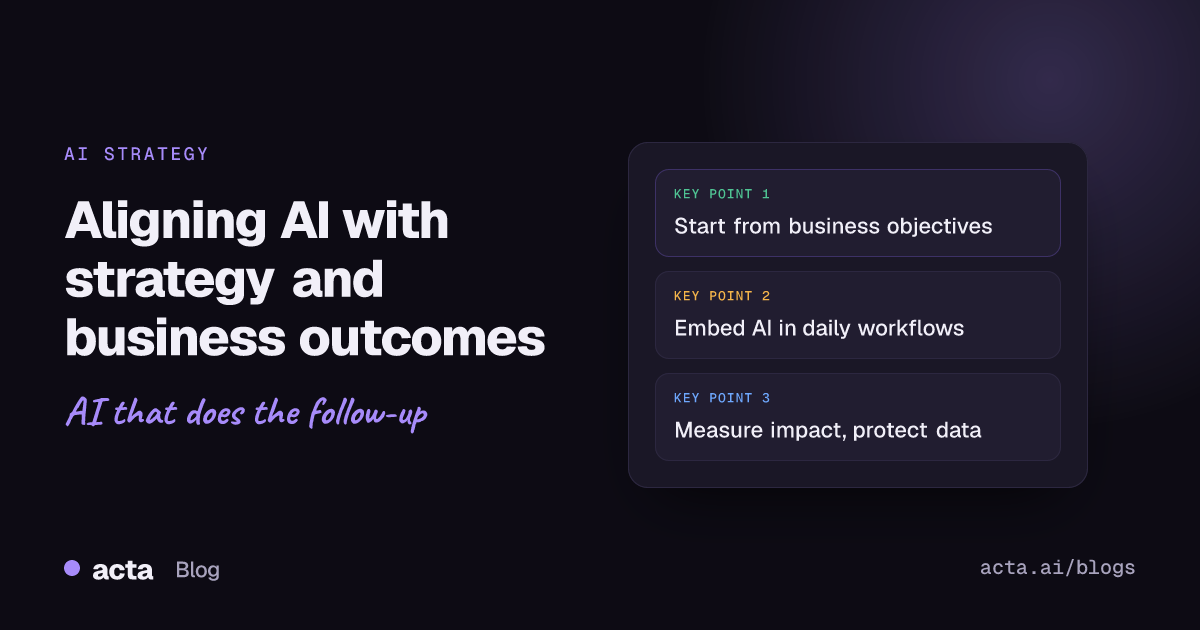
Success starts with clear business objectives. Whether the aim is better decisions, smoother operations, a better customer experience or more revenue, those goals should anchor every AI initiative.
At Acta this principle is fundamental. The product is not just an AI meeting note taker but a set of persona-driven AI agents, each built for the distinct needs of product managers, sales, HR, support and other business units.
How do you map AI capabilities to real-world use cases?
For AI to drive business outcomes, it has to solve high-value, real problems. Acta works with the context of each role and turns unstructured conversations into deliverables such as PRDs, tickets, support summaries and candidate assessments.
By automating time-consuming follow-ups and getting key insights to the right person, it helps improve productivity, project velocity and accountability across the organization. Our post on how sales, HR, support, engineering and leadership use Acta shows what this looks like by team.
How do you bridge strategy and action?
Organizations do best when AI is embedded in daily workflows rather than sitting in a silo. Acta records Google Meet, Microsoft Teams and Zoom calls and connects with tools like Jira, Notion, Confluence, Salesforce and HubSpot, so meeting insights show up inside existing business systems.
Deep integration shortens the loop between conversation and action, which closes operational gaps and leads to better outcomes.
How do you measure the business impact of AI?
True alignment is about measurable results. The outcomes worth tracking include less administrative overhead, clearer project and sales meetings, and more follow-ups actually completed.
Acta supports this with action items that have owners and due dates, consolidated reports across multiple meetings, and project and CTO status reports, so leaders can see progress and refine their strategy. For more on keeping score, read how to track decisions made in meetings.
Why do security and ethics matter for long-term value?
Any strategic AI initiative has to account for privacy and compliance. Acta is built with a privacy-first philosophy: people only see the meetings they have access to, and we explain why we don't use customer data to train our AI models.
That builds trust and fits the governance expectations of regulated industries. Frameworks such as the NIST AI Risk Management Framework are a useful reference when you set your own AI governance standards.
What is the takeaway?
Ground AI initiatives in business strategy, focus on specific pain points and embed outcome-driven AI into everyday workflows. Do that, and every meeting and every conversation can turn into real business value.
Frequently asked questions
Why do many AI initiatives fail to deliver value?
They are often deployed as standalone tools without clear business objectives, so they never connect to the workflows and outcomes that matter.
How do you choose the first AI use case?
Pick a high-value, repetitive problem tied to a business goal, such as post-meeting follow-up, where results are easy to see and measure.
What should you measure after deploying AI?
Measure changes in the outcomes you set out to improve, such as time spent on admin, follow-up completion and project velocity.
See how Acta fits your own strategy: start a free 15-day trial.