Quick answer: Building Acta taught us that AI meeting tools fail when they stop at notes. Organizations struggle because decisions do not stick and actions do not move, not because summaries are bad. What helps is role-based AI that surfaces decisions, owners and next steps for each person, keeps humans in control, and earns trust through quiet reliability rather than flashy features.
By 2026, AI was everywhere. It could write emails, summarize documents, generate code and sit silently in our meetings taking notes. And yet, inside organizations, nothing really felt simpler.
Meetings still ended with:
- "Who owns this?"
- "Was this decided?"
- "I thought you were doing it."
That contradiction is where the Acta journey truly began.
Why was work still messy when AI was so powerful?
Most tools were very good at producing output: clean summaries, bullet points, nice-looking notes.
But organizations do not fail because notes are bad. They fail because decisions do not stick and actions do not move. We realized early:
Productivity isn't about capturing everything said. It's about remembering what actually matters.
What was the real problem in meetings?
We did not start Acta by asking, "How do we build a better AI?" We started by asking, "Why do meetings keep failing people?"
Here is what we consistently saw:
- Everyone attends the same meeting but leaves with a different understanding.
- Notes exist, but ownership does not.
- Follow-ups disappear across email, Slack, Jira and memory.
- One summary is sent to everyone, even though everyone needs something different.
A founder wants decisions and risks. A product manager wants clear requirements. Sales wants objections and next steps. HR wants structured interview insights. A scrum master needs Jira tickets captured. Yet AI tools treated everyone the same.
Why didn't most AI meeting tools really help?
Most tools tried to be smart note-takers. They answered questions like "What was discussed?" and "What was said?"
But real work needs answers to:
- "What did we decide?"
- "Who owns this?"
- "What changes because of this meeting?"
We learned an important lesson:
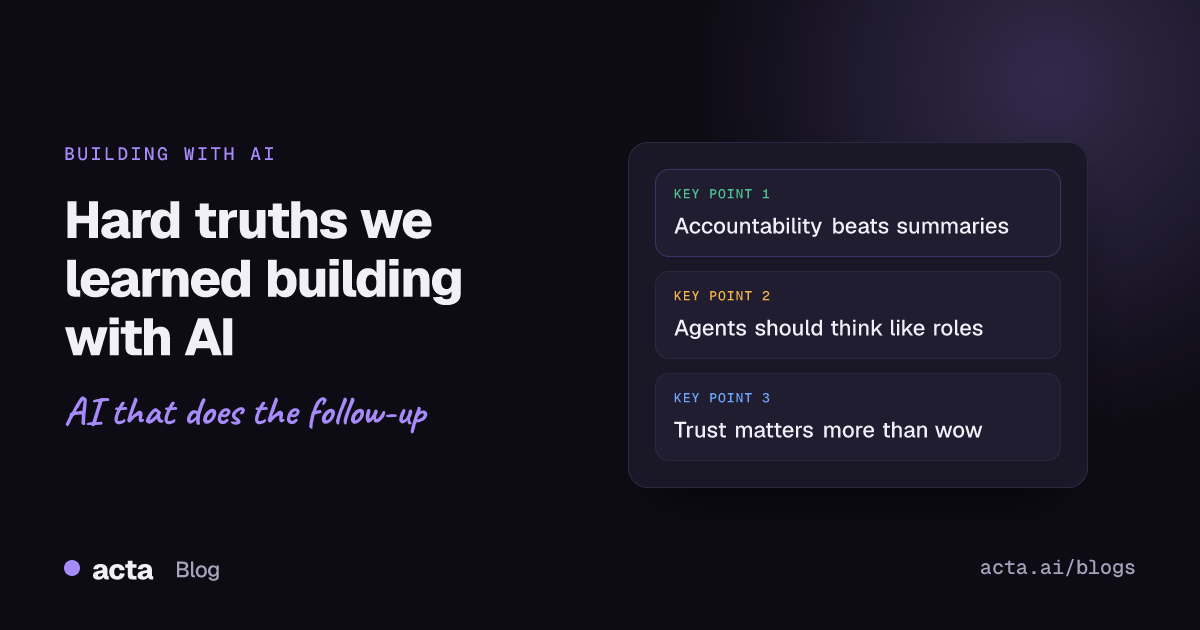
AI summaries don't create clarity. Accountability does.
We go deeper on this in the problem with most AI meeting tools, and how role-based agents solve it.
How did we shift from notes to decision intelligence?
This is where Acta changed direction. Instead of asking AI to summarize meetings, we asked it to think like roles. So we built persona-based AI agents:
- A product agent that thinks in requirements and risks.
- A sales agent that listens for objections and commitments.
- A leadership agent that tracks decisions, dependencies and project status.
- An HR agent that structures candidate feedback.
- A scrum agent that works like a scrum master and creates Jira tickets.
Same meeting. Different intelligence. For example:
- After a product review, the PM does not get a transcript; she gets open decisions, risks and next steps.
- After a sales call, the AE does not get notes; he gets objections, buying signals and follow-ups.
- After a leadership meeting, the founder sees what changed and what is blocked.
That shift changed everything.
How did we stay out of the AI hype trap?
In 2025, it was tempting to promise fully autonomous agents, auto-execution and "sit back while AI runs your business." We chose not to. At Acta:
- AI assists; it does not replace judgment.
- Humans stay in control of decisions.
- Nothing is auto-sent or auto-executed blindly.
- Clarity matters more than cleverness.
Our belief is simple:
AI should reduce thinking load, not thinking responsibility.
What did we learn the hard way?
2025 taught us a few uncomfortable truths:
- More AI features do not mean better adoption.
- Customers do not want intelligence; they want relief.
- Trust matters more than accuracy scores.
- Enterprises care deeply about governance, predictability and control, the same concerns frameworks like the NIST AI Risk Management Framework are built around.
We stopped chasing "wow moments" and focused on quiet reliability.
What is Acta really solving?
Acta is not a meeting recorder, a notes app or a generic AI assistant. Acta is:
- A decision alignment layer.
- A bridge between conversation and execution.
- A role-aware intelligence system for modern teams.
Or simply:
Acta doesn't remember meetings. It remembers what matters.
What comes next: mature AI, not louder AI
What excites us next is not bigger models or louder promises. It is:
- Connecting decisions across meetings, so you can track decisions made in meetings over time.
- Tracking how decisions evolve.
- Turning conversations into sustained execution.
- Building responsible, enterprise-ready AI.
The future of work does not need more noise. It needs more clarity. 2025 tested every AI product in the market. While the hype faded, we doubled down on building AI that delivers real, reliable outcomes, and that is the journey we are committed to continuing.
Frequently asked questions
Why aren't AI meeting summaries enough?
Summaries tell you what was said, but work depends on what was decided, who owns it and what changes as a result. Without that, notes exist but ownership does not.
What are persona-based AI agents?
They are agents that read the same meeting from the point of view of a role, such as product, sales, leadership, HR or scrum, and produce the outputs that role needs.
Does Acta act without human approval?
No. AI assists and humans stay in control of decisions; nothing is auto-sent or auto-executed blindly.
See role-based meeting intelligence for yourself: start a free 15-day Acta trial.