Quick answer: Generic AI summaries tell you what happened in a meeting but rarely why it matters or what to do next. Acta replaces them with domain-specific AI agents: a sales agent that applies MEDDPICC or BANT, a recruiting agent that writes structured assessments, product agents that draft Jira tickets and PRDs, and project, CTO and investor agents that produce ready-to-use reports.
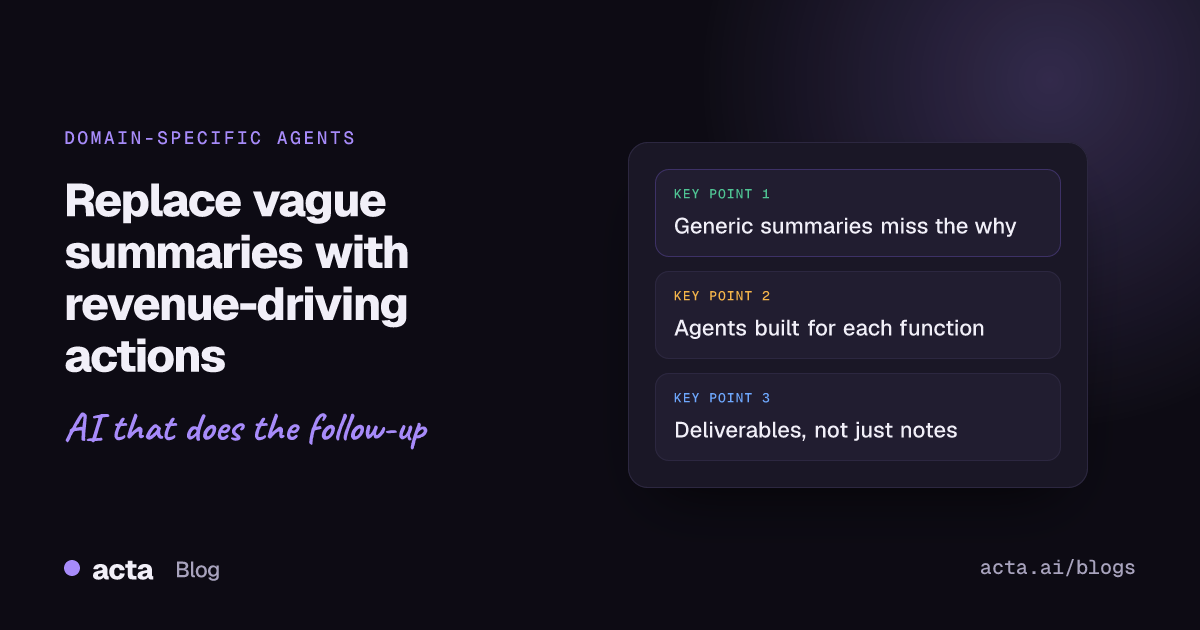
A generic AI tool might tell you what happened on a sales call, or that a customer's engagement dropped, but not why it matters or exactly what to do next.
That gap between information and results is where Acta's specialized AI agents come in. Each one is focused on measurable outcomes for a specific team.
What is wrong with one-size-fits-all AI summaries?
Most AI tools produce the same output for every meeting: a summary, a few bullets, maybe a transcript. Businesses need intelligent agents that understand the context of a sales call, a hiring interview, a support conversation or a team sync.
Generic summaries typically lack:
- Relevance to the task or function
- Awareness of the specific workflow behind the meeting
- Integration with internal systems
- Actionability beyond the conversation itself
The result is shallow analysis that overlooks hidden risks and opportunities, and a kind of decision paralysis where teams spend their time interpreting notes instead of executing on them.
What are domain-specific AI agents?
At Acta, we built specialized AI agents, each focused on one business function. Here is what each one does.
1. Recruiting Agent
- Thorough evaluation: analyzes candidate responses for technical skills and problem-solving ability
- Culture-fit analysis: considers alignment with company values and team dynamics
- Structured feedback: produces detailed reports with strengths, areas to improve and recommendations
See how this works for hiring and recruiting teams.
2. Product Agent: Ticket Creator
- Drafts Jira tickets from meeting discussions
- Captures title, description, type, priority and dependencies
- Records owners and due dates for each task
3. Product Manager Agent
- Generates complete product requirements documents (PRDs)
- Captures clear goals, specific requirements and acceptance criteria
- Documents technical configuration, timelines and budgets
4. Sales Agent
- Applies the MEDDPICC, SPICED, SPIN and BANT frameworks
- Tracks and analyzes sales opportunities
- Recommends next steps and follow-up actions
5. Project Agent
- Creates visual project status reports
- Tracks milestones and identifies risks and blockers
- Manages action items from meeting discussions
6. CTO Agent
- Produces technical reports focused on architecture decisions
- Covers risk assessment and resource planning
- Offers strategic recommendations
7. VC Dealflow Agent
- Analyzes market opportunity and investment potential
- Reviews deal terms and drafts an investment rationale
8. VC Check-in Agent
- Tracks key metrics and progress for portfolio companies
- Identifies challenges and resource needs
9. Product Demo Agent
- Evaluates demo effectiveness and user experience
- Tracks performance metrics and collects feature feedback
How do Acta agents turn raw meetings into business value?
Unlike generic AI tools, Acta's specialized agents:
- Understand role-specific context. Each agent is built around domain knowledge, whether that is sales methodology for the Sales Agent or architecture patterns for the CTO Agent.
- Generate actionable outputs. Instead of passive summaries, they create ready-to-use deliverables such as tickets, PRDs, deal notes and status reports.
- Apply professional frameworks. The Sales Agent applies proven methods like MEDDPICC, while the Project Agent presents progress using familiar project-management conventions.
- Support cross-functional alignment. Different agents can work on the same meeting to give complementary views. For example, the Product Manager Agent and Product Demo Agent can each add their perspective to a product discussion.
How do you get started with Acta's agents?
- Connect and configure. Turn on the agents that match your workflows and connect tools such as Jira, Salesforce or HubSpot.
- Run your meetings. Record with the meeting bot, the bot-free desktop app, the Chrome extension or the mobile apps, or upload a recording.
- Automate and scale. Let the agents handle the repetitive write-ups while your team focuses on strategic work.
Why do specialized agents outperform generic AI?
Traditional meeting AI gives you:
- One-size-fits-all summaries
- Surface-level insights
- Manual work to turn notes into action items
Acta's specialized agents deliver:
- Role-specific intelligence
- Ready-to-use professional deliverables
- Built-in domain expertise
- Integration with the tools your team already uses
We explore the idea further in the problem with most AI meeting tools and how role-based agents solve it.
Frequently asked questions
What is the difference between an AI meeting summary and an AI agent?
A summary records what was said. An agent applies the logic of a specific role, such as a sales framework or a recruiting rubric, and produces a deliverable you can act on.
Which sales frameworks does Acta's Sales Agent support?
It supports MEDDPICC, SPICED, SPIN and BANT, and recommends next steps and follow-ups after each call.
Can several agents analyze the same meeting?
Yes. Different agents can work on the same meeting to give complementary views.
Ready for meeting intelligence built for your role? Try Acta free for 15 days.