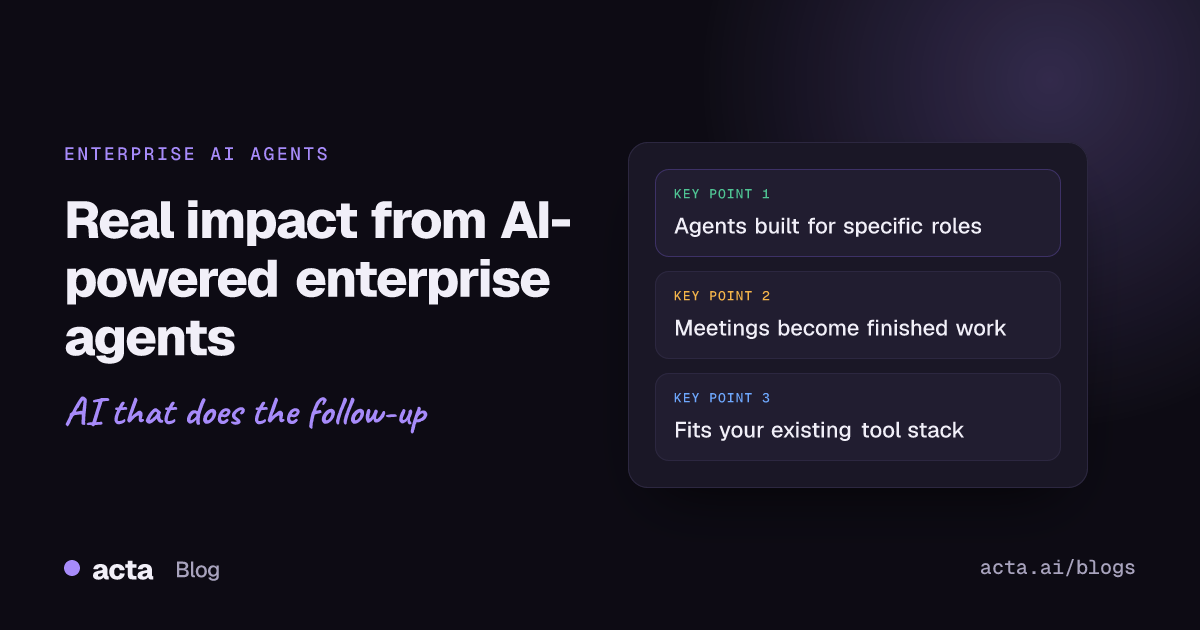
Quick answer: Acta delivers impact with role-based AI agents that work like specialist teammates. A sales agent builds deal reports using frameworks such as MEDDPICC, a scrum agent drafts Jira stories and bugs, a product agent writes requirements and acceptance criteria, and a recruiting agent assesses candidates. Each turns meeting conversations into structured work inside the tools teams already use.
It's easy to get swept up in AI hype, with a new tool every week claiming to change how we work. Amid the noise, only a handful of platforms deliver real, measurable value to businesses. Acta aims to be one of them, through role-based AI agents built for specific enterprise jobs.
Many AI tools promise automation. Acta's AI agents go further by mirroring real team roles, such as sales, support, product management and HR, and applying the speed and consistency of AI to each.
How do Acta agents think and act like teams?
At the heart of Acta's approach are domain-specific AI agents. Each one understands the workflow of its role, produces context-aware output and helps manage the follow-up. Rather than replacing departments, Acta agents augment teams: they take over repetitive work so people can focus on high-impact tasks.
This also addresses a growing enterprise problem: the gap between operational load and the people available to carry it. Research such as Microsoft's Work Trend Index points to the same capacity squeeze. With agents taking on the work behind the work, teams can grow output without growing headcount at the same rate.
What real-world impact do Acta agents have?
Acta's focus is business outcomes. In practice:
- Sales agents turn calls into deal reports and follow-up email drafts, so reps act on what the buyer said while it's fresh. See Acta for sales teams.
- Support agents summarize customer calls and pull out the issues and next steps that need attention.
- Recruiting agents assess candidates from interviews and produce consistent reports for the hiring team.
The aim is faster responses, happier customers, better conversion and lower operational cost, with fewer manual errors and fewer follow-ups that slip. That is augmentation, not just automation.
How do AI agents help people reclaim their focus?
Enterprise professionals are buried in busywork: writing notes, drafting emails, updating systems. Acta agents take on this "work behind the work," freeing people for strategic thinking, creativity and leadership, which is what humans do best.
Unlike generic chatbots, Acta agents are built around business frameworks and your own meeting context, so their output is more relevant and easier to trust.
What can each Acta agent do?
Acta builds specialized, role-based agents that can take on parts of the work of product managers, scrum masters, sales teams, HR and project managers. Each acts on behalf of its role:
- Scrum agent: identifies stories, epics, bugs and updates from engineering meetings and drafts them in Jira.
- Product agent: defines and breaks down requirements, acceptance criteria and test cases, and updates the relevant project tool. More on this for product and engineering teams.
- Sales agent: produces deal reports based on frameworks such as MEDDPICC, BANT, SPIN and SPICED.
- HR and recruiting agent: evaluates candidates and provides a comprehensive assessment report.
Whatever the role, the pattern is the same: the agent understands the context and turns the conversation into structured, usable output such as PRDs, follow-ups, reports, deal summaries and technical breakdowns.
How does Acta fit into the enterprise stack?
Acta integrates with the tools teams already use, including Jira and other ticketing tools, Confluence, Notion, Google Drive, Salesforce, HubSpot and Zoho. Enterprises don't have to change how they work; they just work faster. For a wider look, read Acta Agents: your digital workforce for the enterprise era.
What is the bottom line?
The winners in this wave of AI will adopt it strategically, under pressure to do more with less. Acta isn't just another AI tool; it's a way to build AI-powered teams that improve efficiency, reduce costs and let people do their best work.
Frequently asked questions
What are role-based AI agents?
They are AI agents designed for a specific job, such as sales, product management or recruiting. Each one knows the frameworks and outputs that role needs, rather than giving generic answers.
Do Acta agents replace employees?
No. They take over repetitive work like notes, reports, tickets and follow-up drafts so people can spend more time on decisions, customers and strategy.
Which tools do Acta agents work with?
Acta integrates with Jira and other ticketing tools, Confluence, Notion, Google Drive, Salesforce, HubSpot and Zoho, and records meetings on Zoom, Google Meet and Microsoft Teams.
See what role-based agents can do for your team: start a free 15-day Acta trial.