Quick answer: AI agents make meetings cheaper by taking over the work that surrounds them. An agent such as Acta captures the conversation, assigns action items to owners, highlights topics that need more attention and spots recurring inefficiencies. Attendees can focus on the discussion, there is less post-meeting admin, and fewer follow-up meetings are needed to recover what was agreed.
Meetings are an integral part of professional life. They are where teams collaborate and make decisions. But they come with significant costs, in both time and money.
This article looks at what meetings really cost, the simple habits that reduce that cost, and where an AI meeting agent fits in.
How much time do meetings take?
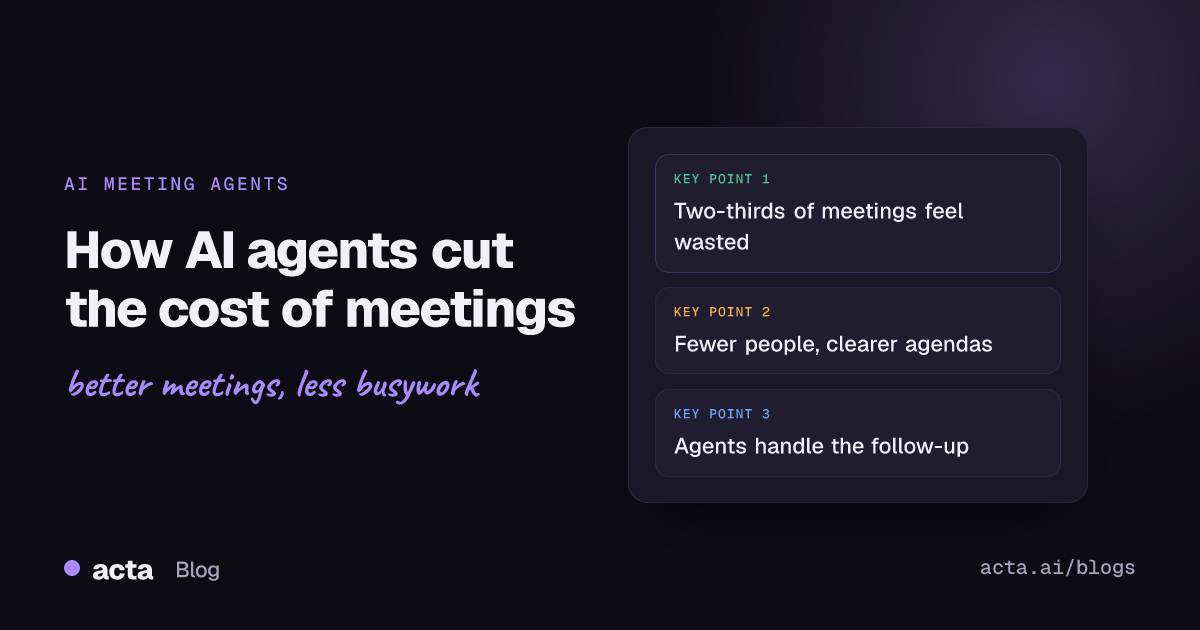
Professionals spend a substantial part of their working week in meetings. Doodle's 2019 State of Meetings report found that the average professional attends about three meetings a week, each lasting roughly an hour. Respondents considered around two-thirds of those meetings unnecessary or a waste of time, which the report estimated at roughly 24 billion lost hours a year across the UK, Germany and the USA.
For senior people the load is far heavier. Harvard Business Review has written about executives who spend around 23 hours a week in meetings.
What do poorly organized meetings cost?
The financial impact is considerable. In the same report, 40% of UK professionals said poorly organized meetings were the biggest cost to their organization, with similar views in Germany (38%) and the USA (34%). Every hour lost in an unproductive meeting is an hour taken away from delivery, which adds up across a company and hits both productivity and profitability.
How can you reduce the cost of meetings?
- Optimize scheduling: use efficient tools to cut the time spent organizing meetings.
- Limit participants: invite only the people who are essential, so meetings stay concise and productive.
- Set clear agendas: define the purpose and objectives beforehand to keep the discussion focused.
- Use technology: choose virtual meetings where appropriate to save on travel time and costs.
How does an AI meeting agent help?
Acta is built to tackle the inefficiencies that remain once a meeting is on the calendar. Its AI agents work on top of the transcript and summary of every meeting. The benefits of using an Acta agent:
- Reduces the post-meeting workload.
- Lets attendees focus fully on the conversation rather than multitasking.
- Improves meeting productivity by identifying redundant discussions.
- Highlights important topics that need more attention.
- Helps organizations identify patterns of inefficiency.
- Supports better planning and decision-making for future meetings.
- Keeps projects on track by clearly assigning responsibilities through action items tracked across meetings.
- Reduces the need for follow-up meetings, saving time and costs.
Acta is more than a meeting assistant; it is a productivity tool. By automating repetitive tasks and providing actionable insights, it helps organizations save time and money while making meetings more effective and meaningful. For a closer look at the idea, read why we need AI agents.
Frequently asked questions
What is an AI agent in a meeting?
It is an AI assistant that works on the meeting's content: it captures what was said, then produces summaries, action items with owners and other structured outputs so people do not have to write them up by hand.
How do AI agents reduce meeting costs?
They cut post-meeting admin, make responsibilities clear and reduce the need for follow-up meetings to recover what was decided.
Do AI agents replace good meeting habits?
No. Clear agendas, fewer participants and better scheduling still matter. An agent handles the work around the meeting so those habits pay off.
See what an agent can take off your plate: try Acta free for 15 days.