Quick answer: We need AI agents because they automate complex, repetitive work that used to need human effort, and they do it at scale. They improve efficiency, are always available, apply the same standard every time, grow with demand and surface insights from data. Acta applies this to meetings, with agents that turn conversations into summaries, action items, tickets, reports and CRM updates.
AI agents are becoming essential across industries because they offer scalable, intelligent automation of tasks that traditionally took up people's time. Here is why they matter and how a platform like Acta helps individuals, teams and organizations. If you want the technical background, see our overview of agent protocols for scalable AI systems.
Why do we need AI agents?
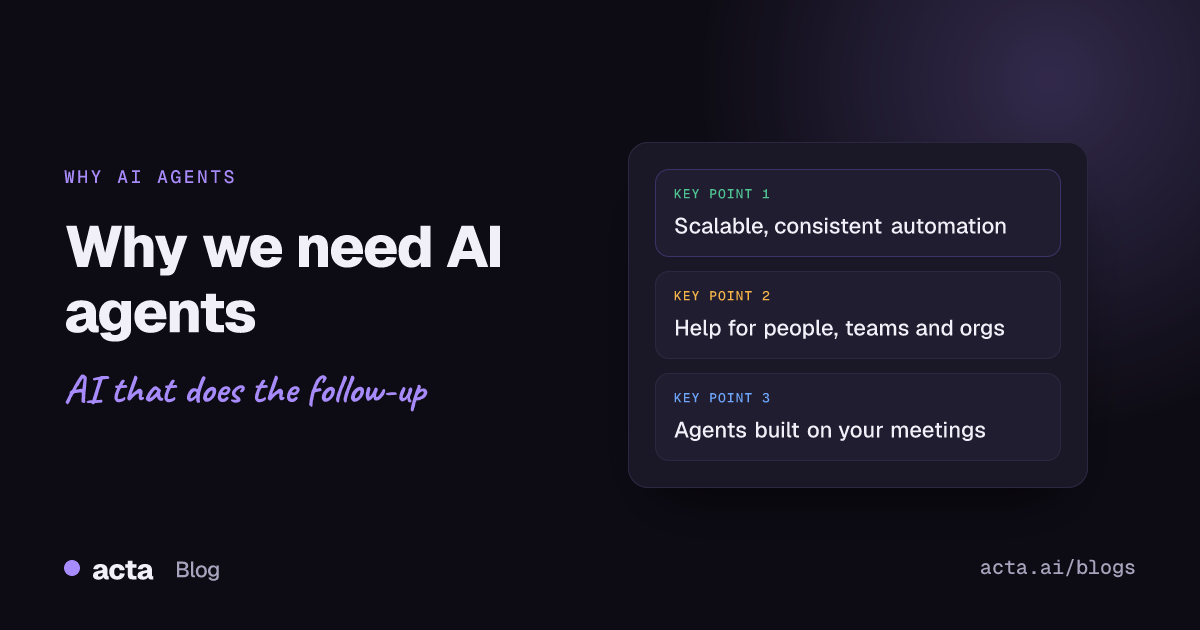
- Efficiency and productivity: agents take on repetitive, time-consuming work so people can focus on judgment and relationships.
- Constant availability: an agent does not need office hours, so work is ready when you are.
- Consistency and accuracy: agents apply the same structure every time, which reduces gaps and errors.
- Scalability: one agent can handle ten meetings or a thousand without extra headcount.
- Data-driven insights: agents can spot patterns across large amounts of information that people would miss.
For guidance on designing agents well, Anthropic's article on building effective agents is a useful starting point.
How can Acta help?
Acta is a platform of AI agents built around your meetings. It records Zoom, Google Meet and Microsoft Teams calls and turns what was said into structured work for individuals, teams and organizations.
For individuals
- Personal productivity: automatic notes, summaries, key takeaways and follow-up email drafts after every meeting.
- Knowledge on demand: OneChat lets you ask questions across all your meetings and uploaded files and get answers with sources. You can also use Acta from ChatGPT or Claude.
For teams
- Meeting agents: record, transcribe, summarize and assign action items with owners and due dates.
- Collaborative agents: send outputs to tools like Jira, Notion, Confluence and Google Drive to keep everyone updated and on task.
- Follow-up help: tracked action items and drafted follow-ups make it easier to get tasks finished.
For organizations
- Customer support agents: analyze support conversations to surface issues and next steps.
- Revenue agents: summarize sales calls with frameworks like MEDDPICC or BANT and update CRMs such as Salesforce, HubSpot and Zoho.
- Recruiting and product agents: produce candidate assessments, PRDs, tickets and project status reports.
Why does Acta stand out?
- Domain-specific agents: tailored to the workflows of sales, recruiting, product, support, marketing and investors.
- Integrations: connects with the tools you already use, including Google Drive, Salesforce, HubSpot, Jira, Confluence and Notion.
- Data privacy: people only see the meetings they have access to, so internal knowledge stays in the right hands.
In summary
We need AI agents to do more with less: faster, smarter and more reliably. Platforms like Acta make that practical by helping individuals automate daily tasks, helping teams collaborate and helping organizations scale with intelligence.
Frequently asked questions
What is an AI agent?
An AI agent is software that uses AI to carry out tasks toward a goal, such as reading a meeting transcript and producing tickets, reports or CRM updates, with little manual effort.
How are AI agents different from AI note takers?
A note taker records and summarizes. An agent goes further and produces finished work, such as a PRD, a candidate assessment or a sales summary in a specific framework.
Do AI agents replace people?
No. They take on repetitive work so people can spend more time on decisions, relationships and judgment.
Want a use-case example for your role or company? Contact the Acta team or try Acta free for 15 days.