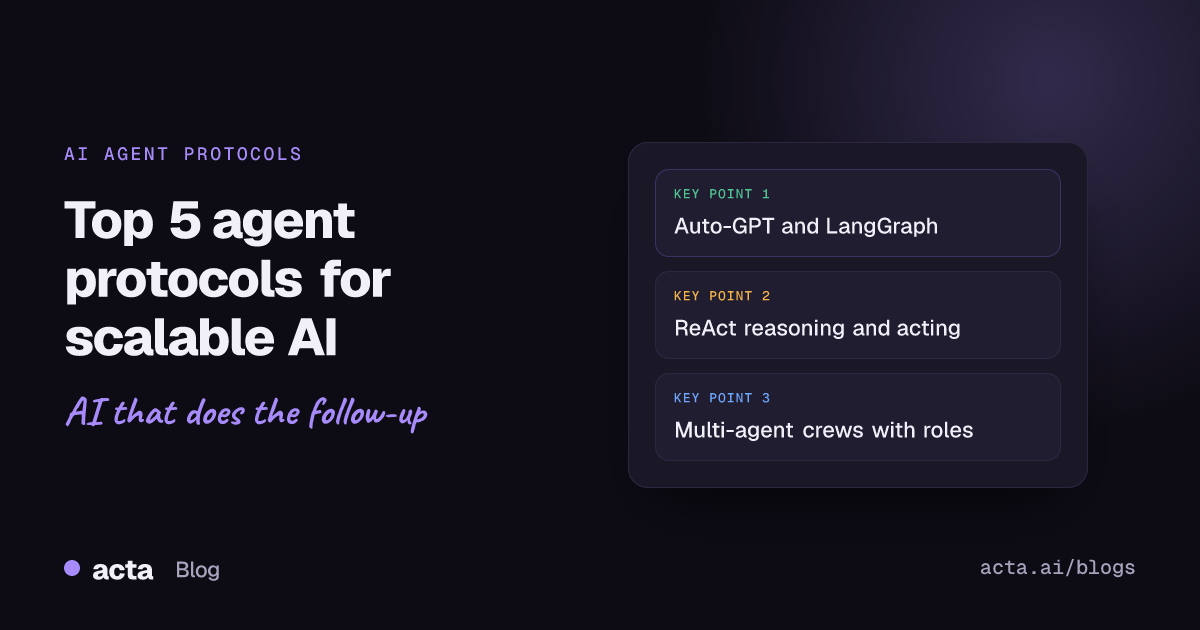
Quick answer: Five widely used approaches for building scalable AI agents are Auto-GPT (autonomous, goal-driven agents), LangGraph (graph-based, stateful workflows), ReAct (a prompting pattern that interleaves reasoning and tool use), the OpenAI Assistants API (hosted agents with tools and memory) and multi-agent frameworks such as CrewAI and MetaGPT, which split work across role-based agents.
AI agents are moving from demos to production, and the protocol or framework you build on shapes how well they scale. Below are five of the most influential options, with what each does well and where it fits. For the bigger picture on why agents matter, see why we need AI agents.
1. What is the Auto-GPT protocol?
- Introduced by: Significant Gravitas (Toran Bruce Richards)
- What it is: one of the first autonomous GPT agents, able to generate and pursue goals using GPT-4.
- Key features: memory, planning, tool use and a plugin architecture.
- Source: AutoGPT on GitHub
Built on OpenAI's GPT models, Auto-GPT lets autonomous agents generate, evaluate and act on goals.
Strengths:
- Goal-oriented task automation
- Combines memory with tool use
- Easy to extend with plugins such as web browsing and file I/O
Use cases: research agents, automated workflows, coding assistants, and general autonomy and tool use.
2. What is LangGraph?
- Introduced by: LangChain
- What it is: a graph-based framework for building persistent, stateful multi-agent workflows.
- Key features: branching, state machines and agent orchestration.
- Source: LangGraph by LangChain
Strengths:
- Supports persistent state and branching logic
- Well suited to multi-step, conditional workflows
- Lets you compose tools, memory and agent logic as modules
Use cases: conversational agents, decision-making systems, document processing and stateful agent flows.
3. What is the ReAct framework?
- Introduced by: Princeton University and Google Research (Yao et al., 2022)
- What it is: a prompting protocol that combines chain-of-thought reasoning with tool use in language models.
- Key features: step-by-step reasoning, action invocation and traceability.
- Paper: ReAct: Synergizing Reasoning and Acting in Language Models
In ReAct, an agent reasons step by step and calls tools based on its own intermediate thoughts.
Strengths:
- Clear, inspectable reasoning chains
- Well suited to tool-using agents
- Helpful for interpretability and debugging
Use cases: question answering, retrieval-augmented generation and interactive agents.
4. What does the OpenAI Assistants API offer for agents?
- Introduced by: OpenAI
- What it is: agent tooling in the OpenAI ecosystem, built around the Assistants API, with support for tools, memory and retrieval.
- Key features: persistent threads, function calling, API integration and orchestration of several assistants.
Strengths:
- Deep integration with OpenAI models and APIs
- Built-in function calling and persistent conversation state
- Can coordinate multiple assistants on a task
Use cases: AI assistants, API orchestration, assistants with memory and customer support.
5. How do multi-agent frameworks like CrewAI and MetaGPT work?
- Inspired by: early projects such as MetaGPT and BabyAGI
- What it is: frameworks for building "crews" or swarms of specialized agents, such as a researcher, planner and developer.
- Key features: role-based agents, shared context and task delegation.
- Example: CrewAI, an open-source multi-agent framework on GitHub
These protocols orchestrate several agents with different roles on one coordinated task, for example a planner, a coder and a critic.
Strengths:
- Division of labor among agents
- Scales across teams of specialized models
- Encourages modularity and collaboration
Use cases: software engineering, content pipelines, multi-agent swarms and research teams.
How do these protocols apply to real products?
The same role-based idea shows up in business tools. Acta, for example, uses domain-specific AI agents for sales, recruiting, product and support conversations, each producing a different kind of output from the same meeting. If you are designing agent systems yourself, our post on moving from prompt engineering to AI systems engineering covers the engineering side.
Frequently asked questions
What is an AI agent protocol?
It is a pattern or framework that defines how an AI agent plans, reasons, uses tools, keeps memory and coordinates with other agents.
What is the difference between ReAct and LangGraph?
ReAct is a prompting pattern that interleaves reasoning steps with tool calls. LangGraph is a framework for building stateful, branching workflows, which can include ReAct-style agents.
When should you use a multi-agent framework?
When a task benefits from specialization, such as research, planning, coding and review, and you want each step handled by an agent with a clear role.
Want to see role-based agents working on conversations? Try Acta free for 15 days.