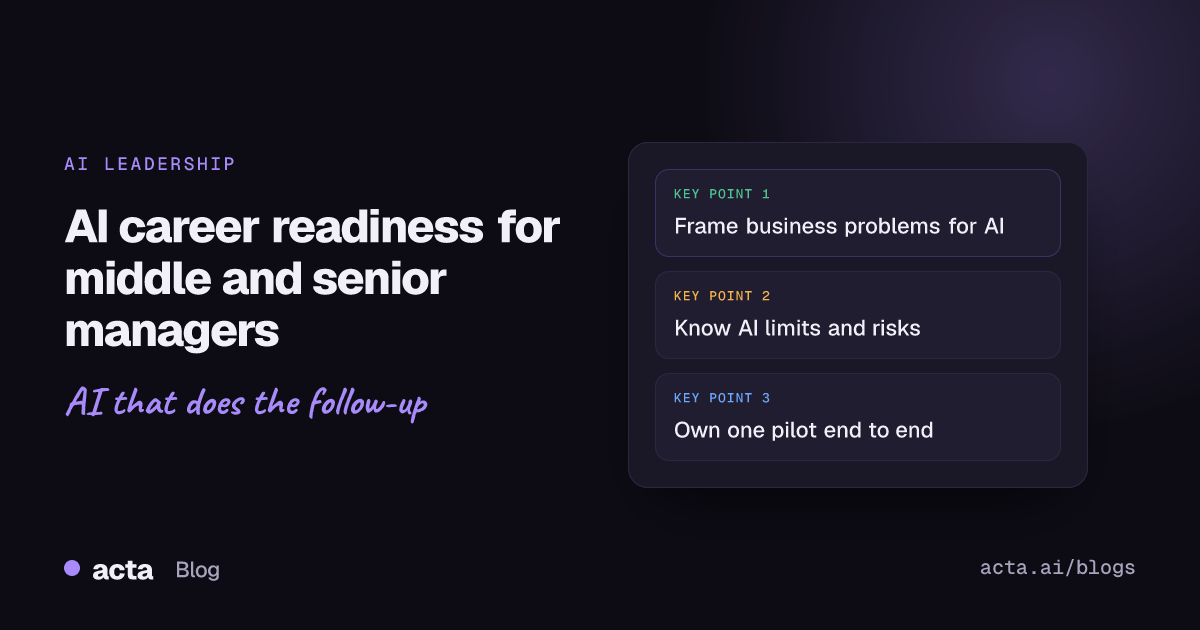
Quick answer: To be AI-ready, middle and senior managers need five things: a strategic sense of where AI creates value, enough AI and data literacy to judge its limits, awareness of the platforms and integrations involved, leadership skills to drive adoption, and a working grasp of governance, compliance and AI risk. The fastest way to build them is to own one AI pilot end to end.
This executive guide explains the skills, enterprise governance practices and AI risk management knowledge that managers need to lead AI initiatives successfully. Each skill comes with a practical example, many of them drawn from how teams use AI on their meetings.
You do not need to become a data scientist. You do need to ask the right questions, set the right guardrails and show measurable results.
What strategic and business skills do managers need for AI?
- AI strategy and vision: understanding where AI creates competitive advantage. Example: spotting rising customer churn and sponsoring an AI-driven churn prediction initiative.
- Business problem framing: translating business challenges into problems AI can solve. Example: turning low sales productivity into a conversation intelligence use case.
- ROI and value measurement: defining KPIs, running a cost-benefit analysis and tracking value realization. Example: measuring the drop in manual reporting once Acta meeting summaries replace hand-written notes. Our guide to measuring the ROI of AI meeting tools shows how.
- AI product thinking: managing the lifecycle from idea to scale. Example: running pilots before scaling AI across departments.
- Change management: driving AI adoption across teams. Example: training teams to use AI insights with confidence.
For a deeper look at tying AI work to business goals, read aligning AI initiatives with organizational strategy.
How much AI and data literacy does a manager need?
Enough to judge what a model can and cannot do, and to know when to push back.
- AI and ML fundamentals: supervised and unsupervised learning, and the basics of generative AI. Example: understanding how a generative AI model produces a meeting summary.
- Data understanding: data quality, bias, labeling and data pipelines. Example: making sure meeting transcripts are accurate and unbiased.
- Model lifecycle awareness: training, testing, deployment and monitoring. Example: knowing when a model needs retraining.
- Limitations of AI: hallucinations, overfitting and explainability challenges. Example: reviewing AI-generated summaries before acting on them.
Which technology and platform topics should managers understand?
- Cloud and AI platforms: AI services on AWS, Azure and GCP. Example: using cloud AI to process enterprise data securely.
- Enterprise AI tools: MLOps, model monitoring and data platforms. Example: connecting Acta to Jira so meeting action items reach the backlog.
- System integration: connecting AI to ERP, CRM, HR and other core systems. Example: syncing AI-captured action items with a CRM such as Salesforce or HubSpot.
- Security by design: identity, access and encryption basics. Example: role-based access so only the right people see sensitive meetings.
What leadership skills matter most when leading AI initiatives?
- Cross-functional leadership: working with data scientists, engineers, legal and business teams. Example: aligning IT, legal and business stakeholders on one rollout plan.
- Talent management: hiring and upskilling AI talent. Example: upskilling product managers on AI tools.
- Decision-making with AI: human-in-the-loop governance. Example: requiring human approval before AI outputs drive decisions.
- Ethical leadership: a responsible AI mindset. Example: preventing misuse of employee data.
What do managers need to know about AI governance and compliance?
- Responsible AI: fairness, transparency and accountability. Example: ensuring explainability for audits.
- Data governance: ownership, consent, lineage and quality standards. Example: defining who owns each dataset.
- Regulatory awareness: GDPR, the EU AI Act and industry-specific rules. Example: checking a new tool against GDPR and internal compliance requirements. The European Commission's overview of the AI regulatory framework is a good starting point.
- Model governance: approval processes, versioning and audit trails. Example: formal approvals before rollout.
What are the main enterprise AI risks?
- Data risks: bias, poor-quality data and privacy violations. Example: sensitive board discussions being exposed.
- Model risks: hallucinations, lack of explainability and model drift. Example: an AI tool producing incorrect insights.
- Operational risks: over-automation, system failures and scalability issues. Example: teams relying on automation without checks.
- Security risks: data leaks, prompt injection and model abuse. Example: unauthorized access to data.
- Reputational risks: ethical misuse and loss of customer trust.
How can managers reduce AI risk in practice?
- Human in the loop: make review of AI outputs mandatory where decisions depend on them.
- Continuous monitoring: track accuracy over time.
- AI usage policies: set clear rules, for example on recording meetings.
- Robust testing: run leadership pilots before scaling.
- Governance committees: hold quarterly AI reviews.
The NIST AI Risk Management Framework offers a structured way to organize this work. To see how Acta handles data protection, visit our security page.
What does an AI career transition roadmap look like?
- Build AI literacy: learn by using everyday AI tools, such as an AI meeting assistant like Acta.
- Own a pilot: lead one AI use case from start to finish.
- Focus on outcomes: demonstrate real productivity gains.
- Stay current on regulation: keep up with new AI laws.
- Position yourself as an AI leader: become known as the person who drives AI transformation.
Managers who combine strategy, governance and responsible AI leadership, supported by the right platforms, will drive lasting enterprise AI transformation.
Frequently asked questions
Do managers need to learn to code to lead AI projects?
No. Managers need to understand AI fundamentals, data quality and model limits well enough to frame problems, set guardrails and judge results.
What is the best first step toward AI career readiness?
Own one AI pilot end to end. It builds literacy, gives you measurable outcomes and shows the organization you can lead AI work.
Which AI risks should senior managers watch most closely?
Data privacy and bias, hallucinations and model drift, over-automation, security threats such as prompt injection, and the reputational damage that follows misuse.
Why does human-in-the-loop review matter?
AI outputs can be wrong or incomplete. Requiring a person to review them before they drive decisions keeps accountability with people.
Planning an enterprise AI initiative? Contact Acta with your use case and we will help you design a scalable, secure AI architecture.