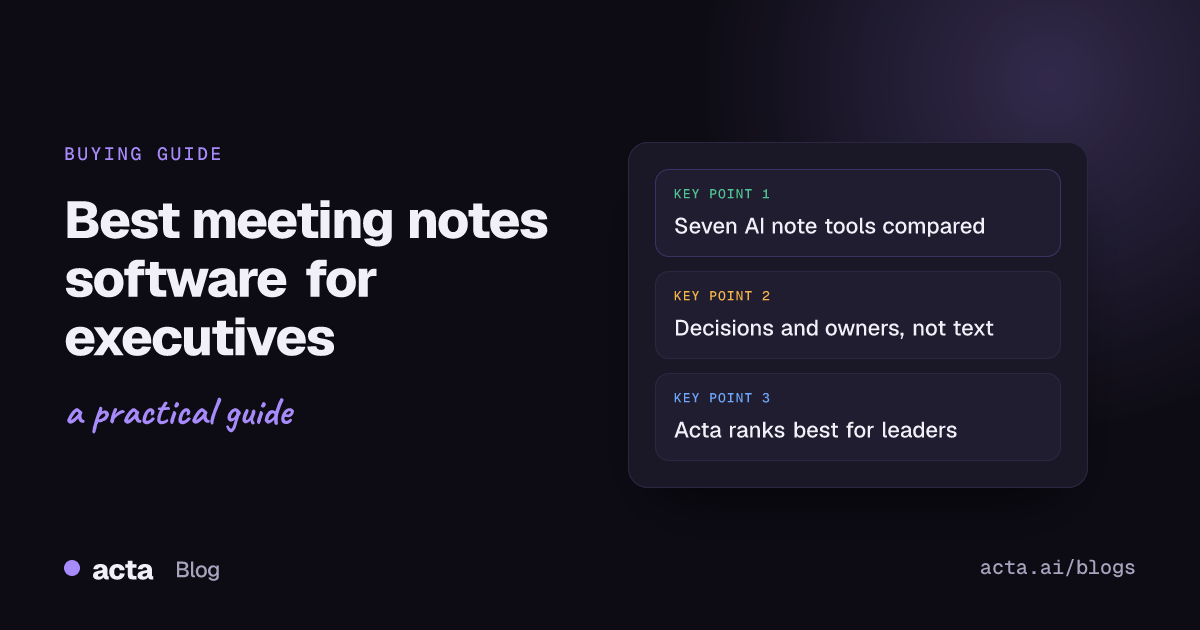
Quick answer: The best meeting notes software in 2026 for executives and enterprise teams is Acta, because it goes beyond transcription to capture decisions, action items with owners and due dates, and concise summaries, and lets leaders ask questions across all their meetings. Fireflies and Otter suit general transcription, Fathom and Avoma suit sales and revenue teams, Sembly AI automates summaries, and Fellow is best for agendas.
Executive meetings have changed. In 2026, leadership teams are no longer looking for basic note-taking apps that simply capture what was said. They need meeting notes software that identifies decisions, summarizes complex discussions, assigns follow-ups and helps teams move from conversation to execution.
For CXOs, CTOs, VPs, directors and senior business leaders, the real value of meeting documentation is not the transcript itself. It is the clarity it creates after the meeting ends. Executives often move between board updates, leadership reviews, customer calls, product strategy meetings, hiring discussions and planning sessions in a single day. Without accurate notes and clear ownership, important decisions get buried in chat threads, email chains or personal notebooks.
This guide compares leading AI meeting notes tools for enterprise and leadership teams: Acta, Fireflies, Otter, Fathom, Avoma, Sembly AI and Fellow. We look at where each platform fits, what it does well and where it may be less suited to an executive operating rhythm.
What is meeting notes software?
Meeting notes software is a digital tool that captures, organizes and shares what happens in meetings. At its simplest, it lets people type notes, create agendas and document next steps. More advanced platforms use AI to record conversations, generate transcripts, summarize discussions, identify speakers, extract action items and highlight decisions.
The biggest shift in recent years has been the move from manual note-taking to AI meeting intelligence. Traditional note-taking depends on someone listening carefully, deciding what matters, writing it down and sending it round afterwards. That breaks down in executive meetings, where discussion moves quickly and everyone is focused on strategy, negotiation, risk or decisions.
For business leaders, the most valuable meeting notes software does four things well:
- Creates a reliable meeting record through transcripts, summaries or searchable archives.
- Separates signal from noise by condensing long conversations into concise summaries.
- Identifies action items, deadlines and owners so follow-through is not left to memory.
- Captures decisions, risks, objections and open issues so leadership teams stay aligned.
A basic tool may help an individual remember a discussion. An AI meeting assistant helps an organization execute. It should also fit into existing workflows, connecting with video conferencing, collaboration and project management tools, and it should support privacy, permissions and governance, because leadership conversations often involve confidential information.
Why do executives need AI meeting notes software in 2026?
Executives spend a large share of their time in meetings, but the value of those meetings depends on what happens afterwards. Harvard Business Review's article Stop the Meeting Madness describes how much senior leaders' time meetings consume.
A leadership discussion may produce an important decision. A customer escalation may reveal a revenue risk. A product review may clarify a strategic priority. If those insights are not captured and assigned to the right owners, momentum is lost.
CXOs and CTOs face a different meeting challenge from individual contributors. Their meetings are high-context, cross-functional and decision-heavy. A CTO may go from architecture planning to vendor evaluation to a security review in a few hours. A CEO may discuss fundraising, hiring, enterprise customers and board priorities on the same day.
An AI meeting assistant helps with three common executive problems:
- Meeting overload: leaders attend back-to-back sessions with little time to process what was discussed.
- Ambiguity: different attendees leave the same meeting with different interpretations.
- Poor follow-through: next steps are not clearly assigned, documented or revisited.
The value is especially strong for distributed teams. When leaders work across locations and time zones, not everyone can attend every meeting. AI summaries keep stakeholders informed without long recordings or full transcripts, which reduces unnecessary meetings.
Executives also need visibility into patterns across meetings. Are the same blockers recurring? Are decisions being delayed? Are customer issues appearing again and again? The best meeting notes software turns meeting data into operational insight, not just documentation.
How did we evaluate the best meeting notes software?
For executives and enterprise teams, the right platform must improve the quality of meeting outcomes, not just create a written record. We used five criteria.
Accuracy and summary quality
If the transcript is unreliable or the summary misses key context, users quickly lose trust. A good tool handles different accents, multiple speakers, technical discussions and fast-moving conversations, and produces concise, structured summaries that show what changed, what was decided and what needs attention.
Executive usability
Senior leaders do not have time for complicated tools. The software should be easy to adopt, easy to read and easy to act on, with clean summaries, clear action items and simple sharing.
Enterprise readiness
This covers security, scalability, admin controls, permissions and governance. Meeting notes may contain customer information, financial updates, product strategy, employee discussions or board-level decisions, so the tool must support proper data handling and access control and scale across departments.
Action item and decision tracking
We looked at how well each tool identifies action items, assigns owners, captures deadlines and documents decisions. A transcript tells you what happened. Decision and action tracking tells you what must happen next.
Workflow integrations
The strongest platforms connect with the tools teams already use: video conferencing for remote and hybrid work, CRM and project management tools for sales, customer success, product and operations, and collaboration tools for sharing.
Best meeting notes software in 2026: quick comparison
- Acta: best overall for executives, CXOs, CTOs, VPs, directors and enterprise teams. Summaries, action items, decision capture, cross-meeting questions and role-based agents, with a strong focus on accountability and leadership alignment.
- Fireflies: best for general transcription. Recording, transcription, searchable meeting records and integrations; useful for documentation, less focused on executive decision workflows.
- Otter: best for simple team notes. Live transcription, summaries and collaborative notes for lightweight documentation.
- Fathom: best for sales calls. Call recording, summaries, highlights and sharing; strong for sales follow-up, narrower for executive operating rhythms.
- Avoma: best for revenue intelligence. Conversation intelligence, coaching and CRM workflows for revenue and customer success teams.
- Sembly AI: best for automated summaries. Summaries, tasks and meeting records for general productivity.
- Fellow: best for agenda-led collaboration. Agendas, templates, feedback and notes; strong for structured meetings, less AI-first.
For leaders, the key question is not "Which tool records meetings?" It is "Which tool helps our leadership team make decisions, assign ownership and stay aligned?" From that perspective, Acta offers the strongest overall fit.
1. Acta: best overall AI meeting notes software for executives
Acta is designed for business leaders who need more than a transcript. CXOs, CTOs, VPs, directors, strategy teams, revenue leaders and operations executives need meeting notes that make decisions visible, action items trackable and follow-up easier across teams.
Why does Acta stand out?
Many meeting tools start with recording and transcription, then add summaries as a convenience. Acta starts from outcomes. It turns business conversations into structured records that are easy to review, share and act on.
Leadership meetings are rarely linear. A strategy session may cover product priorities, customer feedback, budget concerns, hiring constraints and risk. A useful AI meeting assistant has to tell background conversation apart from critical decisions, and Acta's value is in helping leaders quickly understand what matters after the meeting.
It also supports accountability. By capturing action items with owners and due dates, Acta reduces "meeting drift", where everyone agrees in principle but no one owns the follow-up. Decisions are recorded too, which makes it easy to keep a meeting decision log without extra work.
What can Acta do?
- Capture any meeting: Zoom, Google Meet and Microsoft Teams through a meeting bot or the bot-free desktop app, plus a Chrome extension, mobile apps and uploaded recordings.
- Transcripts, summaries and key takeaways, with speakers identified.
- Action items and decisions, with owners and due dates.
- OneChat: ask questions across all your meetings and uploaded files, with answers that cite their sources.
- Multi-meeting reports that consolidate several meetings into one view, plus follow-up email drafts and shareable meeting links.
- Role-based AI agents for sales, recruiting, product, CTO and project status reports, customer support and investors.
- Integrations with Jira and other ticketing tools, Confluence, Notion, Google Drive, Salesforce, HubSpot and Zoho, and access from Claude or ChatGPT through a connector.
- Access control: people only see the meetings they have access to.
Who is Acta best for?
- CXOs and CTOs
- VPs, directors and senior business leaders
- Strategy, operations and revenue leadership teams
- Enterprise teams running frequent high-value meetings
- Scaling organizations where decisions cross departments
For business leaders, the biggest advantage is clarity: a consistent record of what was discussed, what was decided, who owns what and what happens next. Learn more about Acta for leadership teams.
2. Fireflies: best for general meeting transcription
Fireflies is a widely recognized AI meeting assistant known for recording meetings, generating transcripts and making conversations searchable. For teams that want broad transcription coverage across internal meetings, customer calls, interviews and team syncs, it can be a useful option, and it integrates with popular conferencing and productivity tools.
For senior leadership, though, transcription alone is not enough. A CTO does not want to read a full transcript of an architecture review to find the final decision. A CEO does not want to scan a long customer call to spot the revenue risk.
Fireflies is best viewed as a general transcription and meeting archive tool. Acta is better suited to leaders who want meeting intelligence that supports accountability. See the detailed Acta vs Fireflies comparison.
3. Otter: best for simple transcription and team notes
Otter is one of the most familiar names in AI transcription. It is commonly used for live transcripts, shared notes, interviews, lectures and general business meetings, and its main appeal is accessibility: a simple way to create transcripts, review conversations and collaborate on notes.
For business leaders, the requirements are usually higher. A transcript provides completeness, but not always clarity. A senior executive reviewing several meetings a day wants a clean brief: decisions made, risks raised, blockers identified and next steps assigned.
Otter is a good choice for simple transcription and collaborative notes. For leaders who want notes to drive accountability, Acta is the stronger business-focused alternative. Compare them in Acta vs Otter.
4. Fathom: best for sales and customer-facing calls
Fathom is well known for helping teams record, summarize and share customer-facing conversations. It is popular with sales professionals, customer success teams and account managers who need to capture call highlights and follow up quickly, which makes it useful for discovery calls, demos, onboarding and check-ins.
Its focus is narrower for enterprise leadership. It is built around customer-call productivity rather than broad executive meeting intelligence. Executives also need support for strategy reviews, operating meetings, board updates, product planning and internal escalations, where decision tracking and organizational visibility go beyond a single customer interaction.
Fathom is better for sales-call workflows. Acta is better for executives and senior teams who want structured outcomes from high-value business conversations.
5. Avoma: best for revenue and customer success teams
Avoma is positioned as a meeting intelligence platform for revenue, customer success and go-to-market teams. It focuses on conversation intelligence, coaching, call analysis and CRM workflows, helping teams identify objections, track deal progress and coach representatives.
For senior leaders, that revenue orientation may not cover the full range of needs. CXOs and CTOs need notes across strategy, product, finance, operations, people, legal, security and customer conversations, and they may not want a platform designed mainly around sales coaching.
Avoma is a strong choice for revenue and customer success teams. For executive productivity and alignment across departments, Acta offers a more leadership-focused experience.
6. Sembly AI: best for automated meeting summaries
Sembly AI helps teams automate meeting notes, summaries and tasks. It generates meeting records and identifies key points, which makes it relevant for internal meetings, recurring syncs, project updates and general collaboration.
Executive teams, however, need summaries that are strategically useful: which decisions were made, which actions are urgent, which risks were raised and where alignment is missing. The gap between a helpful summary and an executive-ready one can be significant.
Sembly AI fits teams that want automated documentation. Acta is better positioned for leadership teams that want meeting intelligence tied to outcomes.
7. Fellow: best for meeting agendas and team collaboration
Fellow is a meeting management platform focused on agendas, notes, feedback and structured team workflows. It helps managers build consistent meeting habits, run one-on-ones and check-ins, and prepare topics in advance. That matters, because many meetings fail before they begin through unclear purpose or poor preparation.
Fellow is different from an AI-first meeting intelligence platform. Leaders who need deeper automation around summaries, decisions and action items may find agenda structure helpful but not sufficient.
Put simply, Fellow helps teams run better meetings, while Acta helps teams turn meetings into outcomes. If you already have strong meeting discipline and mainly need agendas, Fellow may be useful. If you need AI summaries and executive meeting intelligence, Acta is the stronger choice.
How does Acta compare with other meeting notes tools?
The main distinction is focus. Many platforms are built around transcription, sales calls, agenda management or general productivity. Acta is built around executive meeting intelligence and business outcomes.
- Acta vs Fireflies: if your goal is to search meeting history, Fireflies may help. If your goal is decision clarity and follow-through, Acta fits better.
- Acta vs Otter: Otter is best for simple transcription and shared notes. Acta adds executive summaries, decision capture and action item ownership.
- Acta vs Fathom: Fathom is optimized for customer-facing calls. Acta covers strategy meetings, operating reviews, product discussions and executive alignment sessions as well.
- Acta vs Avoma: revenue leaders may prefer Avoma for sales performance. CXOs and CTOs may prefer Acta for alignment across the whole enterprise.
- Acta vs Fellow: Fellow helps plan meetings. Acta captures what happened and drives what happens next.
What features should you look for in meeting notes software?
The best AI note taker for enterprise meetings should help teams summarize, decide, assign, protect and integrate meeting information.
- AI-generated summaries: concise, accurate and context-aware, so leaders see what changed, what was agreed and what needs attention without reading a transcript.
- Action item ownership: next steps with owners and deadlines, which improves accountability and cuts follow-up clarification.
- Decision and risk capture: a reliable record stops teams revisiting the same topic and surfaces blockers, dependencies and unresolved concerns early.
- Enterprise security and privacy: review access controls, permissions, data handling, storage and compliance before rollout. Acta's approach is described on our security page.
- Workflow integrations: video meeting, CRM, collaboration and project management integrations reduce friction. If a tool needs too much manual effort, adoption suffers.
Which meeting notes software is best for each use case?
- Best for CXOs and CTOs: Acta, built for executive decision-making, leadership alignment and clarity across complex conversations.
- Best for enterprise meetings: Acta, for business-ready meeting intelligence, access control and adoption across teams. Fireflies and Sembly AI also support broad documentation.
- Best for sales teams: Fathom and Avoma focus on customer conversations and revenue workflows. Acta also supports sales leaders with sales agents and visibility into decisions, customer themes and follow-ups.
- Best for general transcription: Otter and Fireflies are practical when the goal is a written record.
How do you choose the right meeting notes software in 2026?
The right platform improves productivity and alignment. The wrong one becomes another unused tool. Use this framework:
- Define your primary use case. Are you improving executive productivity, capturing enterprise meetings, summarizing sales calls, replacing manual notes or improving internal collaboration? If leadership clarity and decision tracking come first, Acta is the strongest choice.
- Evaluate security and data requirements. Review privacy, permissions, storage and compliance, especially for board meetings, customer conversations, financial discussions, HR matters and product strategy.
- Test summary quality and action item accuracy on real meetings. Do not judge a platform only on demo content. Check whether it captures context, identifies decisions and extracts action items correctly.
- Consider adoption across leadership teams. A tool is only valuable if people use it. The interface should be simple, the output useful and sharing easy.
Related reading: Best Otter Alternatives in 2026: 7 Apps Like Otter Compared
Frequently asked questions
What is the best meeting notes software in 2026?
For executives and enterprise teams, Acta is our top pick. It combines AI meeting notes, executive summaries, action items with owners, decision capture and questions across meetings. Other tools suit transcription, sales calls or agendas.
Can AI meeting notes software replace manual note-taking?
Largely, yes. It generates transcripts, summaries, action items and meeting records automatically, though teams should still review notes when decisions are sensitive or complex.
Is AI meeting notes software secure for enterprise meetings?
It can be, when the platform provides strong data handling, permissions, privacy controls and governance. Evaluate these before rolling a tool out to leadership meetings.
Which AI meeting assistant is best for CXOs and CTOs?
Acta is well suited to leadership meetings, strategy discussions, technical reviews and cross-functional planning, with CTO and project status reports among its agents.
The best meeting notes software helps leaders turn meetings into clarity, clarity into accountability and accountability into execution. Start a free 15-day Acta trial to see it on your own leadership meetings.