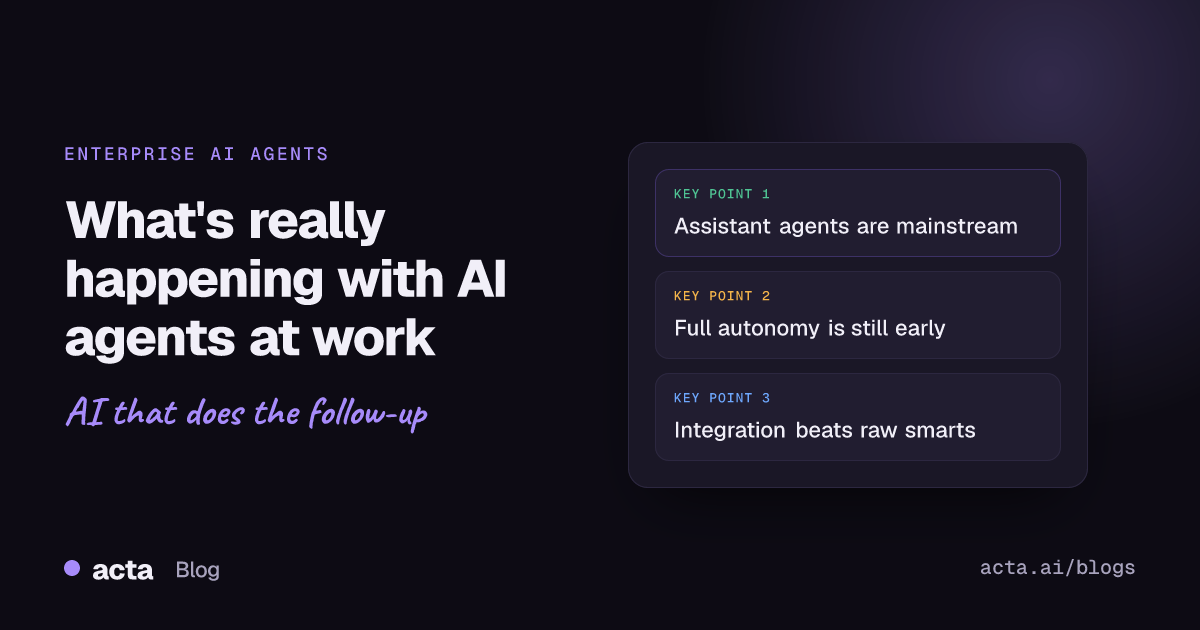
Quick answer: AI agents are already in production in the enterprise, but mostly as supervised assistants inside clear boundaries. Copilot-style assistants, tier-1 support bots and sales agents that turn calls into CRM updates are working today. Fully autonomous, multi-step agents and company-wide orchestration remain experimental, held back by reliability, integration, access control and governance concerns.
AI agents get a lot of attention, and it can be hard to tell the demos from the deployments. This article separates what is real and working today from what is still evolving, and looks at where enterprise adoption is heading.
The short version: the competitive edge comes less from how smart an agent is and more from how well it is integrated into a company's processes, data and systems.
Which AI agents are actually working in enterprises today?
1. AI agents as assistants: high adoption
- Copilot-style agents are now built into tools such as Microsoft 365, Google Workspace, Salesforce and Zoom.
- Common tasks include summarizing emails and meetings, drafting documents and replies, auto-completing forms or CRM entries, and generating code or internal documentation.
Reality: widely used and proven in enterprises, especially in knowledge work.
2. Customer support and IT helpdesk agents: operational
- AI agents handle tier-1 support: answering FAQs, triaging issues to human agents and performing basic IT tasks such as password resets and permission changes.
- Typical tools include Zendesk bots, ServiceNow Virtual Agents and IBM Watson Assistant.
Reality: effective in structured domains with known intents and workflows.
3. Sales and CRM automation agents: emerging
- Agents such as Acta, or tools built into Salesforce, can listen to sales calls, extract action items and keep CRM records up to date.
- This cuts admin time and improves data quality.
Reality: gaining traction where call volume is high and structured follow-up matters. Acta's AI for sales teams applies frameworks such as MEDDPICC and BANT to every call and connects to Salesforce, HubSpot and Zoho.
What is still evolving?
1. Autonomous, multi-step AI agents
- The goal: AI that can decide, plan and execute across systems, in the style of AutoGPT.
- Why it is still experimental: hallucination risk, unreliable APIs, and a lack of robust monitoring, rollback and trust.
Reality: not yet ready for unsupervised work in critical business areas. Anthropic's guide to building effective agents makes a similar case for starting with simple, well-defined workflows.
2. Enterprise-wide orchestration agents
- The vision: an AI layer that talks to SAP, Jira, Notion, Slack, email and databases and handles workflows end to end.
- The real barriers: deep system integration, complex access controls and data privacy, and change management inside organizations.
Reality: some progress through custom hybrids of robotic process automation (RPA) and large language models, but still immature.
3. Legal, compliance and governance concerns
- Enterprises hesitate to fully trust AI with sensitive decisions or data.
- The challenges include explainability, audit trails and regulatory uncertainty, particularly in finance, healthcare and law.
Reality: human-in-the-loop design remains essential.
How are large companies deploying AI agents?
Microsoft
Copilot for Microsoft 365 puts AI inside Outlook, Word, Excel and Teams, covering meeting summaries, email drafting and explanations of data in Excel. It is already in wide use across companies that run on the Microsoft stack.
Accenture
Accenture has described using AI agents internally for code review, contract analysis and internal search, with an internal orchestration platform to govern how teams use large language models. It also offers AI agents to clients in banking, telecom and government, so its use spans both horizontal and industry-specific work.
Salesforce
Einstein GPT and Einstein Copilot generate CRM summaries after client calls, suggest next steps, fill in lead forms and draft messages, with integration into Slack and Salesforce Cloud. The focus is automating work for sales and service teams.
Where are enterprise AI agents heading next?
- Hybrid agents that combine large language models with structured automation and rules engines.
- More domain-specific agents, such as a compliance bot, a legal clause checker or an HR interview assistant. Acta's AI agents follow this pattern, with agents for sales, recruiting, product, support and investors.
- Native integration into platforms such as Google Cloud, AWS, Microsoft and SAP, which will speed up adoption.
Where are AI agents being adopted fastest?
AI agents are spreading fastest where they:
- Save measurable time, for example after-meeting summaries
- Work with structured data, for example CRM and IT service management systems
- Run repeatable processes, for example legal review and ticket resolution
The next frontier is cross-system orchestration, where an agent does not just summarize or answer but acts: submitting forms, triggering workflows and sending follow-ups, with security, reliability and auditability built in. For more on why this matters, read why we need AI agents and our overview of agent protocols for scalable AI systems.
Bottom line: AI agents are no longer science fiction. They are in production today, but with human supervision and within clear boundaries.
Frequently asked questions
Are AI agents actually used in enterprises today?
Yes. Assistant-style agents in productivity suites, tier-1 support and helpdesk bots, and sales agents that update CRMs are all in production, usually with a person reviewing the output.
Why aren't fully autonomous AI agents widely deployed yet?
They still face hallucination risk, unreliable integrations and weak monitoring and rollback. Most enterprises are not ready to let them act unsupervised in critical areas.
What makes an enterprise AI agent successful?
Tight integration with the company's processes, data and systems, a clear and repeatable task, and human-in-the-loop review where decisions carry risk.
Which teams benefit first from AI agents?
Teams with high volumes of structured, repeatable work, such as sales, customer support, IT helpdesk and anyone who spends time writing up meetings.
Want to see a domain-specific agent at work on your own meetings? Start a free 15-day Acta trial.