Quick answer: Software and technology organizations are moving AI from experiments into core operations, and their budgets are changing with it. Instead of paying for a single model or chatbot, they now fund models, cloud and data infrastructure, agents, integration, security, governance, evaluation and training. The strongest budgets are tied to measurable outcomes such as hours saved, cost per ticket or forecast accuracy.
A few years ago, most companies were experimenting with large language models, chatbots and generative AI. Today they are building AI into software development, customer service, sales, finance, operations, cybersecurity, knowledge management and decision-making.
The bigger change is not that companies are using more AI. It is that they are changing how they budget for, govern, deploy and measure it. The question for technology leaders has moved from "What can AI do?" to:
"Where should we deploy AI, how much should we invest, and what measurable business value will it create?"
Why has AI become a strategic technology investment?
Enterprise AI adoption is accelerating across industries. One 2026 study of ChatGPT Enterprise usage, covering more than 1,500 organizations and around 17 million messages, found that usage had grown quickly and spanned technical work, writing, communication and information synthesis. Adoption was most concentrated in larger organizations with significant R&D and SG&A activity. Microsoft's Work Trend Index tracks a similar spread of AI across everyday knowledge work.
The important point is that AI is no longer limited to data-science teams. It now shows up in almost every role:
- Software engineers use it for code generation, code review, test creation, debugging, documentation and architecture exploration.
- Salespeople use it for account research, meeting preparation, proposal generation, CRM updates and sales-call analysis.
- Managers use it for meeting summaries, decision tracking, project-risk analysis, business reporting and knowledge discovery.
- Customer-support teams use AI agents to understand customer questions, search knowledge bases, resolve simple issues, escalate complex cases and update support systems.
As a result, organizations increasingly treat AI as a horizontal capability rather than one department's technology.
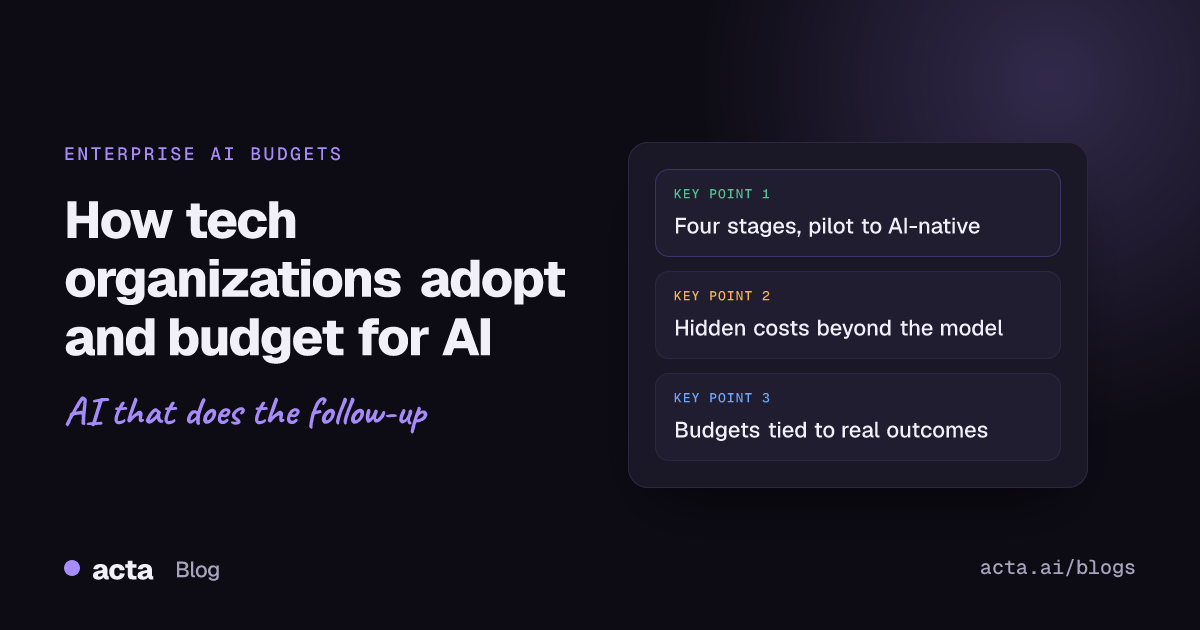
What are the four stages of enterprise AI adoption?
Most organizations do not jump straight from experimentation to enterprise-wide AI. They usually move through four stages, and the budget question changes at each one.
Stage 1: Experimentation
Employees and small teams start trying ChatGPT, Claude, Gemini, coding assistants, open-source models and AI APIs. The budget is usually modest: perhaps $10K to $50K for tools, plus cloud and API consumption, small proofs of concept and developer experimentation.
The main question: "Can AI solve this problem?"
Stage 2: Department-level adoption
Once a use case works, it is rolled out inside a department. Typical examples:
- AI coding assistants for engineering
- AI assistants for sales
- AI search for legal teams
- AI document processing for finance
- AI support agents for customer service
Spending starts to move from an innovation budget into the department's operating budget. The question becomes: "Can we demonstrate measurable productivity or business improvement?"
Stage 3: Enterprise scaling
Successful use cases are connected to enterprise systems. A typical flow looks like this:
- An employee asks an AI assistant for help.
- The assistant draws on enterprise knowledge through RAG and search.
- An AI agent uses MCP, APIs and tools to reach systems such as CRM, ERP, Jira, HR and finance.
- The result is a business action, not just an answer.
At this stage an LLM on its own is not enough. Organizations need AI platform architecture, identity and access management, data governance, RAG and vector databases, model gateways, agent orchestration, evaluation frameworks, observability, security, guardrails, human approval and auditability.
The question becomes: "How do we safely scale AI across the organization?"
Stage 4: AI-native organization
The most advanced organizations start redesigning processes around AI. Instead of asking "Where can we add AI to the existing process?", they ask:
"If AI were available from day one, how would we design this process?"
That produces AI-native workflows in which agents handle parts of the work that used to be done manually.
What are organizations actually budgeting for?
AI budgets are much broader than an LLM subscription. A mature enterprise AI budget covers several categories.
AI models
Organizations may use models from OpenAI, Anthropic, Google and Microsoft, alongside open-source and specialized models. More and more companies use several models rather than relying on one provider, for example:
- Simple tasks go to a low-cost model
- Complex reasoning goes to a premium model
- Private workloads run on an open-source model
- Sensitive data stays in a controlled or private deployment
That creates a new requirement: model routing and model governance.
Cloud and GPU infrastructure
AI workloads need serious compute: GPUs and other accelerators, cloud inference, model hosting, storage, networking and data centers. This matters most for technology companies building their own AI products. The scale of the infrastructure race is large enough that, as Reuters reported in August 2026, investors are now asking not only how much Big Tech is spending on AI infrastructure but which companies will earn a return on it.
Data infrastructure
AI is only as useful as the data it can reach. Companies therefore invest in data lakes and warehouses, vector databases, knowledge graphs, metadata systems, data pipelines, document processing and enterprise search.
This is where retrieval-augmented generation (RAG), first described in a 2020 research paper, becomes important. A company may hold thousands of PDFs, emails, meeting transcripts, CRM records, Jira tickets, contracts, policies and product documents. An enterprise AI assistant needs controlled access to all of it. Meeting transcripts are a good example of a hard case; we explain the challenges in how we cracked the multi-meeting RAG challenge.
How are AI agents changing the budget equation?
One of the biggest shifts now under way is the move from AI assistants to AI agents. A traditional assistant might answer "What is the status of Project X?" An agent could:
- Search Jira
- Retrieve project documentation
- Analyze recent meetings
- Identify overdue tasks
- Check customer complaints
- Assess risks
- Prepare a report
- Update the project-management system
- Notify the project manager
That is much closer to workflow automation than to chatbot use. So instead of budgeting for "AI + chatbot", organizations are starting to budget for AI + data + tools + workflow + governance. For a grounded view of where agents are working today, see what is actually happening with AI agents in the enterprise.
What do real companies show about AI investment?
Three large organizations illustrate different sides of the same shift.
JPMorgan Chase: AI justified by operational metrics
JPMorgan is one of the clearest examples of treating AI as an enterprise capability. In its 2025 annual reporting, the bank said more than 90% of its engineers use AI coding assistants and more than 65,000 Corporate & Investment Bank employees actively use its LLM Suite.
It uses AI for transaction screening, software engineering, client advice, research, meeting preparation, market analysis, risk management and treasury forecasting. In transaction screening, JPMorgan reported that AI let it review more than twice the volume while cutting manual operator checks by half.
The lesson: AI investment is increasingly justified through operational metrics. "We invested in AI because it is strategically important" is a weak argument. "AI lets us process twice the workload with fewer manual checks" is a strong one.
Morgan Stanley: evaluation becomes part of the budget
Morgan Stanley worked with OpenAI to build AI tools for financial advisors. Its internal AI @ Morgan Stanley Assistant helps advisors retrieve information from the firm's knowledge base. According to OpenAI's published case study, more than 98% of advisor teams actively use it, document access rose from roughly 20% to 80%, and advisors gained more time for client relationships.
The most interesting part is not the chatbot but the evaluation framework around it. Before deploying a use case, the firm checks accuracy, reliability, quality, real-world performance and expert feedback. That reflects a wider change: AI evaluation is becoming part of the AI budget. You cannot buy a model and assume it will produce reliable results.
Accenture: AI as a growth business and a skills investment
Accenture is building AI capabilities as a major business line, not only adopting them internally. It reported that in fiscal 2025 its revenue from generative and increasingly agentic AI reached $2.7 billion, roughly triple the previous year, and that generative AI bookings nearly doubled to $5.9 billion.
It also invested heavily in acquisitions, R&D, AI platforms and training, reporting around $1 billion in learning and development in fiscal 2025 and roughly 47 million hours of employee training, with generative AI a major focus. The lesson: AI budgets increasingly include people and skills, because buying technology without training people does not guarantee adoption.
How should leaders measure AI investments?
Technology leaders increasingly manage AI as a portfolio, with each investment tied to its own objective and metric:
- Coding AI: developer productivity, measured in engineering hours saved
- Customer AI agents: lower support cost, measured as cost per ticket
- Sales AI: sales productivity, measured in revenue and conversion
- Enterprise RAG: less time spent searching for information, measured in search time
- Meeting intelligence: better execution, measured in action-item completion
- AI forecasting: better planning, measured in forecast accuracy
- AI automation: less manual work, measured in hours eliminated
- AI security: lower risk, measured in incidents prevented
This changes how CIOs and CTOs think. The question is no longer "How much does this AI tool cost?" but "What economic value does this AI capability generate?" Meeting intelligence is a good example: the value is not the transcript, it is whether decisions and action items actually get done, which is why AI meeting notes alone are not enough for enterprise teams.
Why is ROI the hardest part of AI budgeting?
Organizations have shown that AI can deliver impressive results on individual tasks. Scaling those results across an enterprise is much harder.
A 2026 research paper describes this as a "deployment wall": companies can spend heavily on pilots without turning them into measurable P&L impact. Its argument is that production deployment friction, not model capability, is a major reason AI projects fail to create value. That is why budgets now include integration, data preparation, security, governance, evaluation, monitoring, change management and workflow redesign. Productionizing AI can cost far more than the original proof of concept.
What does the hidden AI budget look like?
Take a company that wants an AI customer-support agent. The obvious budget is an LLM API plus application development. The real budget usually adds:
- Cloud hosting and data preparation
- RAG over the knowledge base
- CRM integration
- Security and identity
- Evaluation, monitoring and guardrails
- Human escalation and ongoing support
- Training for the team that works alongside it
This is why enterprise AI projects often become much more expensive when they move from prototype to production.
Why are organizations budgeting for AI governance?
AI introduces new risks: hallucinations, data leakage, privacy, bias, intellectual property, regulatory compliance, unauthorized agents, prompt injection, excessive agent permissions and incorrect automated decisions.
Risk depends heavily on what an agent can do. An agent that can read CRM data is relatively low risk. One that can modify customer records, approve payments, delete data, send contracts or change pricing has a much higher risk profile.
So enterprise AI architecture increasingly puts governance on top, supported by security, evaluations and observability, which sit over the AI platform, which in turn runs the models, agents and RAG that connect to enterprise systems. Frameworks such as the NIST AI Risk Management Framework give teams a shared structure for this work, and vendors should be able to explain their own controls clearly, as we do on our security and privacy page.
What skills and roles does AI adoption require?
AI adoption creates demand for new roles: AI and ML engineers, AI architects, data engineers, AI product managers, AI platform and security engineers, governance and evaluation specialists, prompt and context engineers, and agentic AI developers.
Just as important, existing employees are being trained to use AI, which is why companies such as Accenture invest so heavily in learning and development. The future workforce probably will not split into "AI employees" and "non-AI employees". Instead, many roles will become AI-enabled roles.
How is software engineering being reshaped?
Software engineering receives some of the largest AI investment. The traditional path of requirement, design, coding, testing, code review and deployment is turning into:
- Requirement
- AI-assisted design
- AI-assisted coding
- AI-generated tests
- AI code review
- Automated security analysis
- CI/CD
- Human approval
With more than 90% of JPMorgan's engineers already using AI coding assistants, companies may increasingly budget for developer productivity platforms rather than individual coding tools.
How is AI spending split between CapEx, OpEx and people?
For hyperscalers and major technology companies, AI infrastructure is a board-level investment worth billions in data centers, GPUs, networking, power, cooling, accelerators and cloud capacity. That is a different economy from an enterprise buying an AI SaaS product. Two groups are emerging:
- AI consumers: banks, retailers, manufacturers, healthcare companies and software companies using AI to improve their businesses.
- AI infrastructure providers: cloud providers, semiconductor and GPU manufacturers, data-center operators and networking companies building what makes AI possible.
Traditional IT budgeting separates CapEx from OpEx. AI blurs the line, so a single company may carry:
- CapEx: GPUs, data centers, servers and networking
- OpEx: LLM API usage, cloud inference, SaaS AI tools, AI agents and data services
- People: AI engineers, consultants, training and research
CFOs need a more sophisticated cost model as a result.
What is AI FinOps?
AI also creates the need for AI FinOps. For an agent that processes millions of documents, the company needs to understand tokens consumed, model cost, retrieval cost, GPU utilization, API calls, agent execution cost, storage and embedding cost.
A single user request might trigger an agent that makes five tool calls, three retrieval operations and two LLM calls before it returns an answer. The organization needs to know: what did that one business task cost? In time, AI cost accounting is likely to become as routine as cloud cost accounting.
What should an enterprise AI budget look like?
The strongest organizations budget along the line of budget, capability, outcome rather than budget, tool. Compare two business cases:
- Weak: "We need $500,000 for an enterprise AI platform."
- Strong: "We will automate 40% of customer-support interactions, reduce average handling time by 30% and save $1.5 million a year."
The second is far easier for a CFO to approve.
There is no universal percentage every company should spend on AI. The budget should reflect maturity and objectives. One practical way to split it:
- 10-15% experimentation: proofs of concept, model evaluation, new tools and emerging technologies
- 20-30% AI platform: model access, RAG, agent frameworks, APIs, infrastructure and data
- 15-25% production applications: customer agents and AI for sales, engineering, finance and operations
- 10-15% security and governance: AI security, evaluations, guardrails, compliance and monitoring
- 10-20% people and training: AI engineers, architecture, training and change management
These are planning ranges, not industry benchmarks. The right allocation depends on whether the organization is an AI consumer, an AI software vendor or an AI infrastructure provider.
What is the main lesson for technology leaders?
The first wave of enterprise AI was about experimentation. The second was about productivity. The current wave is about production, automation, agents and measurable ROI.
Organizations are budgeting for the whole system that makes AI work at scale: models, data, infrastructure, agents, integration, security, governance, people and measurement. JPMorgan is using AI to improve productivity and financial operations. Morgan Stanley is using it to change knowledge access and advisor workflows. Accenture treats generative and agentic AI as both an internal capability and a growth business.
AI spending is no longer about buying AI. It is about building an organization capable of turning AI into measurable business value.
That is likely to be the defining enterprise technology challenge of the next several years.
Frequently asked questions
What should an enterprise AI budget include?
Beyond model access, it should cover cloud and data infrastructure, integration, security, governance, evaluation, monitoring, change management and training. These production costs often exceed the cost of the original proof of concept.
How much of the budget should go to AI governance?
One practical planning range is 10-15% for security and governance, covering guardrails, evaluations, compliance and monitoring. It is a starting point, not a benchmark, and depends on how much autonomy your agents have.
Why do AI pilots fail to deliver ROI?
Often because of deployment friction rather than model capability. Integration, data preparation, governance and workflow redesign are underfunded, so pilots never become production systems with measurable outcomes.
How do you build a strong AI business case?
Tie the investment to a specific outcome and metric, such as cost per ticket, hours saved or action-item completion, instead of asking for budget for a platform or tool.
Want to see outcome-focused AI applied to your own meetings? Start a free 15-day Acta trial.