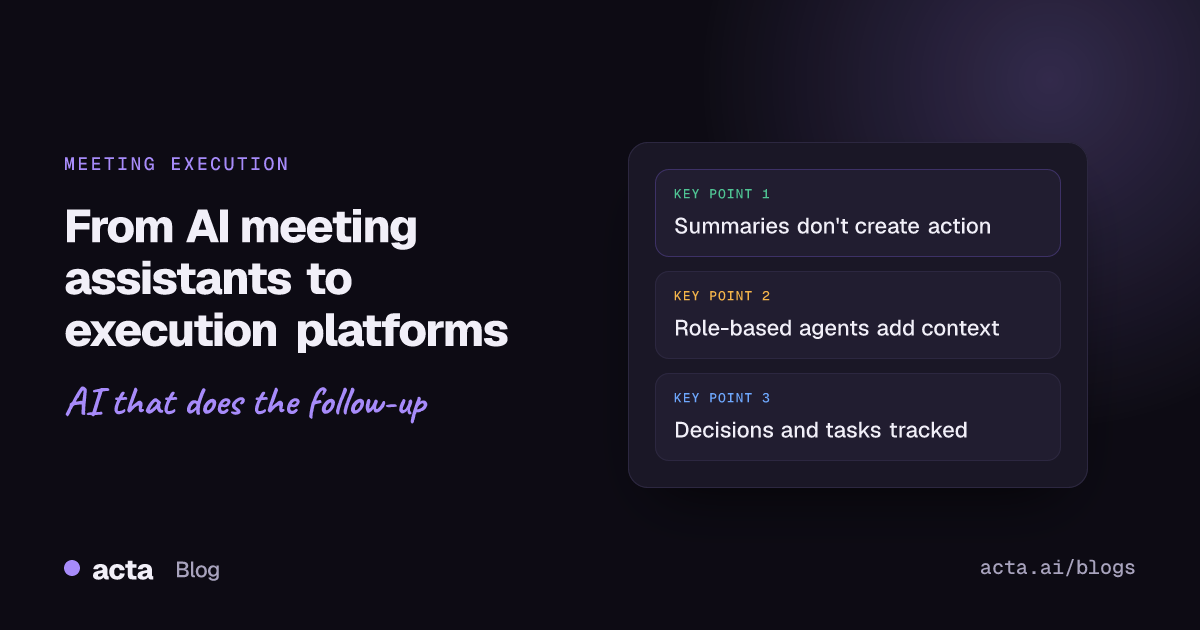
Quick answer: An AI meeting execution platform goes beyond recording, transcribing and summarizing. It tracks decisions, creates tasks with owners, connects insights across meetings and pushes work into tools like Jira. AI note-takers capture conversations; execution platforms turn them into outcomes, often through role-based AI agents that understand what a product manager, sales leader or CTO needs from a meeting.
For the past few years, AI note-takers have promised to fix meetings. They record. They transcribe. They summarize. Yet most teams still face the same issue:
Meetings happen. Work doesn't.
The real problem isn't capturing conversations. It's turning them into execution.
How has AI in meetings evolved?
- Recording: tools focused on storing meetings.
- Transcription: speech-to-text made conversations searchable.
- Summarization: AI began generating notes and highlights.
- Execution (now): the next shift isn't about better summaries. It's about decisions tracked automatically, tasks created instantly and ownership assigned without friction.
Why are AI note-takers no longer enough?
Most AI meeting tools fall short in three areas. We go deeper on this in why AI meeting notes aren't enough for enterprise teams.
1. Lack of context
Generic summaries don't understand roles. What matters to a product manager is different from what matters to a sales leader or a CTO.
2. No continuity across meetings
Insights stay isolated in individual calls instead of building up over time.
3. No execution layer
There is no automatic task creation, follow-up or workflow integration. The result is a large execution gap between what was discussed and what gets done.
What is an AI meeting execution platform?
An AI meeting execution platform goes beyond notes. It acts as a system of action, not just a system of record. Its core capabilities include:
- Role-based AI agents
- Cross-meeting intelligence
- Automated task creation
- Decision tracking
- Workflow integration
How are AI agents changing meetings?
Instead of a single generic assistant, organizations now use specialized agents:
- Sales agents track deals and next steps.
- Product agents generate PRDs and capture requirements.
- Scrum agents create Jira tickets from the conversation.
- Support agents structure customer issues.
This shift means faster execution, better alignment and less manual effort.
How does Acta turn conversations into execution?
Acta is built for this new approach. Instead of acting as a passive note-taker, it works as an AI-native meeting execution platform.
1. Persona-based AI agents
Each meeting can be analyzed through role-specific lenses with Acta's AI agents, covering product, sales, HR and recruiting, engineering, customer support and scrum masters.
2. Cross-meeting intelligence
Acta connects conversations over time into a searchable knowledge layer. OneChat answers questions across all your meetings with sources, and consolidated reports pull many meetings into one view.
3. Automated execution
From a single meeting, Acta can:
- Generate action items
- Assign owners and due dates
- Track decisions
- Send work into Jira and other ticketing tools (see how meeting action items become Jira tickets)
4. Built for enterprise
People only see the meetings they have access to, and Acta offers deployment options for organizations with strict data requirements, including an on-premises AI meeting assistant. More detail is on our security page.
What is the business impact of a meeting execution platform?
Teams that move from note-taking to execution can expect:
- Less administrative work after every meeting
- Faster decision-making cycles
- Clearer accountability
- Better cross-team collaboration
Most importantly, meetings start producing outcomes, not just notes. Acta listens like a personal assistant, understands like a business analyst and follows through like a manager.
Frequently asked questions
What is the difference between an AI note-taker and an execution platform?
A note-taker records, transcribes and summarizes. An execution platform also tracks decisions, creates owned tasks, connects meetings over time and pushes work into your tools.
Why do role-based AI agents matter in meetings?
Different roles need different outputs from the same meeting. Role-based agents produce, for example, deal next steps for sales, PRDs for product and Jira tickets for engineering.
Can Acta create Jira tickets from meetings?
Yes. Acta integrates with Jira and other ticketing tools, and its product agents draft tickets from engineering meetings.
Turn your next meeting into outcomes, not just notes: try Acta free for 15 days.