Quick answer: Innovative destruction is what happens when a company adopts AI the wrong way: it bolts AI onto existing products and workflows instead of rethinking them, and erodes its own advantage as a result. Intercom's shift to an AI-native model built around its Fin agent shows the alternative. Winning companies put AI at the core and move from producing outputs to executing work.
AI was supposed to accelerate innovation. For many companies, it is accelerating irrelevance instead.
The real risk is not missing AI but misapplying it, which leads to what we call innovative destruction.
What is innovative destruction?
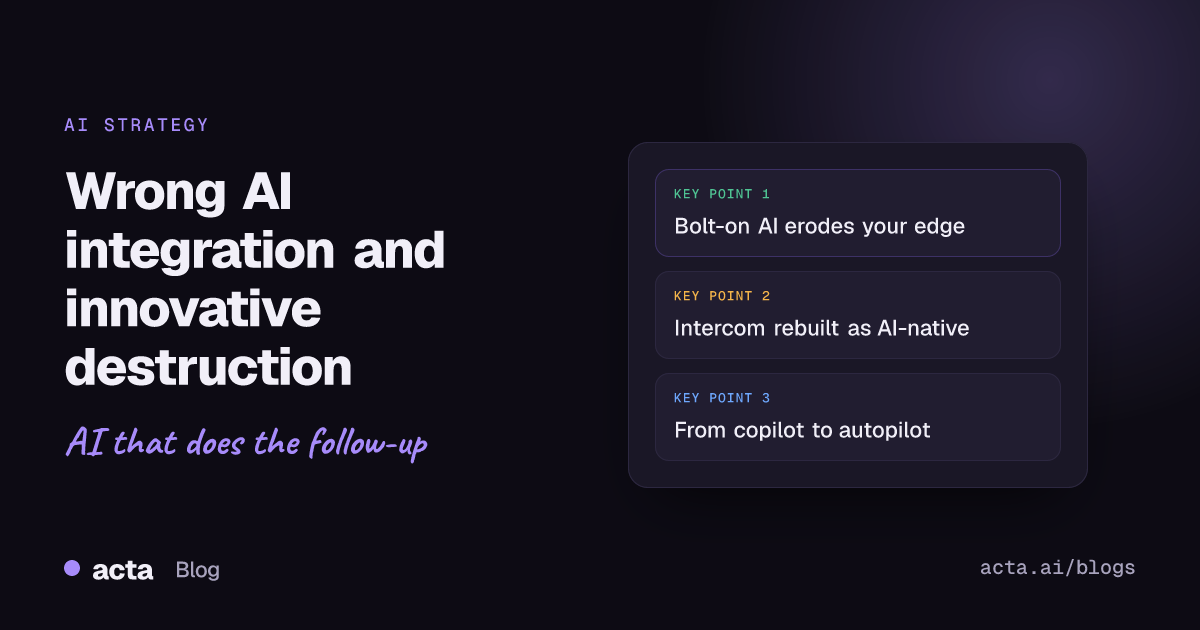
Innovative destruction means a bad AI strategy destroys your own advantage. When companies adopt AI without rethinking their product, they do not evolve. They erode.
Anyone leading an AI initiative should know the Intercom story.
What happened to Intercom when AI changed the rules?
For years, Intercom was a category-defining company in customer communication. It reimagined support with chat-first experiences, intuitive design and human-centered interactions. It was not just a product. It was the standard.
Then AI changed the rules. Generative AI was not an evolution. It reset the entire industry. Customer expectations shifted almost overnight: chat became a commodity, automation became the baseline, and intelligence became the real product.
This is where many companies, including strong and well-led ones, made a critical mistake. They tried to add AI to existing systems instead of rethinking the system itself.
Why doesn't "adding AI to what we have" work?
Many companies started from the same assumption: "Let's add AI to what we already have."
But AI does not behave like a feature. It reshapes workflows, pricing models, team structures and product value. Layered onto legacy thinking, it creates friction instead of advantage.
In our reading, Intercom made exactly this misstep early in the AI transition. It first focused on improving existing workflows with AI as a feature, while the market had already moved to a new model. What had made it successful, its chat experience, UX and human-led support, quickly lost its edge as automation and outcomes became the new standard. The mistake was not capability. It was approach: trying to evolve the product when the moment demanded a reset.
How did Intercom reinvent itself?
Intercom itself later emphasized that successful teams are not bolting on AI but rebuilding the system so AI sits at the core. It then:
- Rebuilt itself as an AI-native company
- Launched Fin, its AI agent, as the core product
- Shifted its focus from tools to outcomes
By the company's own public accounts, Fin now handles a large share of its customers' support conversations and has become a major part of its business.
Intercom did not collapse, but it was forced into a rapid reinvention cycle. It had to introduce AI agents, reposition its value and realign its product strategy. That was not optimization. It was survival.
Where does innovative destruction come from?
It does not come from competitors alone. It comes from holding on to outdated workflows and assumptions in a world that has already moved on.
The companies that win this era are not AI-enabled. They are AI-native. If your AI still needs people to organize its outputs, assign tasks and manually carry out the next steps, it is not solving the problem. It is speeding up an outdated process. We make a similar argument in AI meeting assistants are dead: execution platforms are the future.
What does AI-native work look like?
The future of work is moving toward a different model: from conversation to execution, automatically. That is what Acta is built for. It removes post-meeting admin by turning conversations into action items with owners and due dates, decisions, follow-up email drafts, and outputs from domain-specific AI agents such as Jira tickets, PRDs and CRM updates.
Most companies are still building copilots. The market is moving toward autopilot, and that is where the next generation of products will be defined. If you are planning your own rollout, read our lessons on aligning AI initiatives with strategy and business outcomes.
Frequently asked questions
What does innovative destruction mean in AI?
It describes a company damaging its own advantage by adopting AI badly, usually by adding AI features to old workflows instead of rethinking the product around AI.
What is the difference between AI-enabled and AI-native?
An AI-enabled company adds AI to existing processes. An AI-native company designs its product and workflows with AI at the core, so the AI produces outcomes rather than just assisting people.
What is the lesson from Intercom's AI transition?
Strong products can lose their edge quickly when AI resets customer expectations. Intercom responded by rebuilding around its Fin AI agent and focusing on outcomes rather than tools.
See what conversation-to-execution looks like for your meetings: try Acta free for 15 days.