Quick answer: The "memo tax" is the 10 to 15 hours a week that venture associates spend transcribing founder calls, digging through notes and drafting investment memos by hand. An AI meeting assistant like Acta closes that gap by recording each call, turning it into a structured deal summary, and keeping a searchable record of every conversation, so associates spend their time on judgment instead of admin.
In venture capital, time is the one resource you cannot get back. For most investment teams, the gap between a great meeting and a signed term sheet is filled with a grueling manual process: the memo tax.
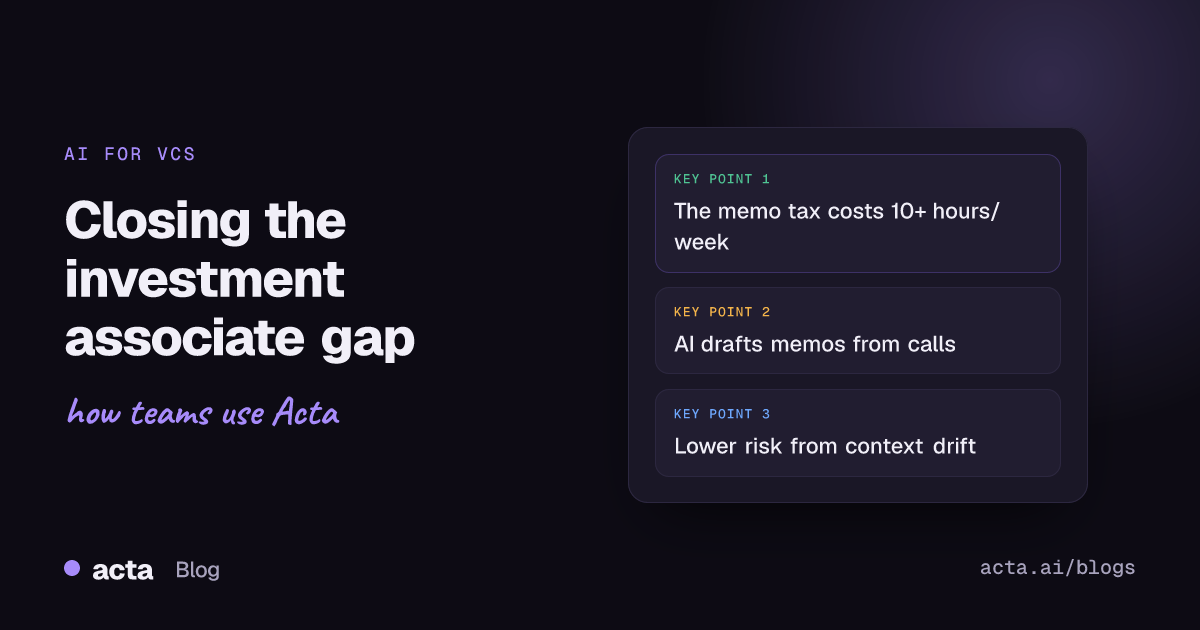
If you are an associate at a mid-market fund or a principal at a boutique firm, you know it well. It is the 10 to 15 hours a week spent transcribing founder calls, sorting disorganized notes and drafting memos. While partners hunt for the next breakout company, the engine room of the fund stalls on administrative overhead. In the workflows we have looked at, the firms pulling ahead are not only the ones with the best networks. They are the ones that have used AI to close this "associate gap."
What is the memo tax?
Associates screen startups through 25 to 30 minute intro calls, probing team background, problem-solution fit, traction and market size. They then write deal memos covering the company overview, market analysis, financials, team strengths, risks and an investment recommendation. Repeat that at high volume and burnout follows.
The memo tax is the hidden cost of lost context. When an associate takes five intro calls in one afternoon, the nuances of the third founder's pivot or the unit economics of the fifth startup start to blur. Memos come out incomplete, missing competitive edges or execution risks, and that weakens partner pitches, due diligence and ultimately fund performance.
To cope, VCs have traditionally relied on a manual workflow:
- Recording: basic transcription tools that produce a wall of text.
- Extraction: up to an hour per call re-listening to audio for key metrics such as ARR, churn and burn rate.
- Synthesis: mapping those metrics by hand into the firm's investment memo template.
- Reporting: typing the data into a CRM.
This process is not just slow, it is risky. When you are tired and overworked, you miss the red flags that separate a 1x return from a 100x exit.
What is an AI investment associate?
The answer is not hiring more junior staff. It is giving the team an AI-first operating system. Acta works as a digital investment associate that captures every call so no insight is lost. Its AI agents include ones built for investor dealflow and portfolio check-ins.
From a wall of text to structured logic
Most AI transcription tools hand you a transcript. Acta's Dealflow agent hands you a structured investment summary. It follows the logic of a pitch, separating the value proposition from the go-to-market strategy and organizing what the founder said into team, market, traction and fundraising, the building blocks of a memo draft. We cover the agents in more detail in your AI-first operating system for venture capital and angel investors.
Ending the CRM black hole
For many VCs, the CRM is where data goes to die because nobody has time to update it. Acta integrates with CRMs such as HubSpot, Salesforce and Zoho, so details like a founder's bridge-round timeline can reach your records without hours of manual entry.
Catching red flags after the call
While you focus on building rapport with the founder, Acta captures the full conversation. Afterwards you can ask it pointed questions across the call and your other meetings, with sources. If a founder quoted 2% monthly churn but later described a retention problem that does not fit that number, you can find both moments and check them before the next step.
How much are 10 hours a week worth?
Here is an illustrative calculation for a typical venture firm:
- Average associate salary: roughly $150,000 to $250,000
- Hours lost to the memo tax: about 10 a week
- Annual cost of manual admin: roughly $40,000 to $60,000 per associate
Reclaim those 10 hours and an associate could take around five more discovery calls a week. Over a year, that is about 250 more chances to find the fund-returner your competitors missed because they were busy formatting a Word document.
Why is 10 hours only the tip of the iceberg?
ROI calculations usually focus on productivity: the hours reclaimed. For a high-performing fund, the risk-reduction gains are often worth more.
1. Context drift
Every time someone summarizes a meeting from memory or messy notes, context drifts. We filter out information that does not fit our first impression.
- The risk: an associate glosses over a founder's vague answer about customer concentration because the pitch deck looks great.
- The AI fix: Acta keeps an objective, verbatim transcript. Reviewing it, or asking Acta where the founder was non-committal, prompts a closer look before the investment committee meets.
2. Compliance and duty of care
Institutional LPs increasingly expect a clear record of how deals were vetted.
- The risk: if an investment fails because of fraud or undisclosed liabilities, the GP may need to show it did proper diligence.
- The AI fix: Acta builds a searchable paper trail of founder syncs, expert calls and reference checks, which protects the firm's reputation.
3. The anti-portfolio risk
The biggest risk in venture is often not a company going to zero but missing the one that goes 100x because your team was too slow.
- The risk: a promising founder sends a follow-up question on Friday afternoon. The associate, buried in five hours of memo drafting, replies on Tuesday. By then another fund has issued a term sheet.
- The AI fix: with the admin load automated, response times shrink. In a competitive market, speed reduces risk.
4. The single point of failure
In many funds, the context for a deal lives in one person's head.
- The risk: if a principal leaves mid-deal or is out sick for the final IC meeting, the institutional memory of that deal goes with them.
- The AI fix: Acta spreads that knowledge across the team. Anyone with access to the meetings can ask questions across past meetings to understand a founder's vision, even if they were not on the call.
The new ROI formula
ROI = reclaimed salary + opportunity value of new deals + lower risk of capital loss
Factor in avoiding just one bad deal, or catching one company you would otherwise have missed, and the return is measured in multiples of the fund rather than hours. For more on this idea, read why your next 10x return is buried in yesterday's meeting.
How do you close the associate gap quickly?
Becoming an AI-native firm does not require a large transformation project. It starts with your meetings.
- Capture your calls: let Acta join Zoom, Google Meet or Teams calls, or use the bot-free desktop app for founder conversations.
- Turn on the investor agents: enable the Dealflow agent for pitches and the Monthly Check-ins agent for portfolio calls.
- Send the output where you work: share summaries to Notion, Confluence or Google Drive, and use them as the first draft of your memo.
Why is the future of VC context-rich?
The best VCs will walk into every partner meeting with full recall of every founder they have met. AI will draft the first version of the memo, leaving people to do what AI cannot: apply judgment.
The memo tax is optional. The question for your firm is whether you keep paying it or reinvest that time in winning deals. See how Acta supports venture capital and angel investors, from intro calls to the investment committee.
Frequently asked questions
What is the memo tax in venture capital?
It is the time associates spend turning founder calls into investment memos by hand: re-listening to recordings, pulling out metrics and formatting them into the firm's template. It often runs to 10 to 15 hours a week.
Can AI write an investment memo from a pitch meeting?
AI can produce a structured first draft. Acta's Dealflow agent summarizes a pitch into team, market, traction and fundraising, which an associate then reviews and refines with their own judgment.
How does an AI meeting assistant reduce deal risk?
It keeps a verbatim, searchable record of every call, so vague or contradictory answers can be checked later and deal knowledge does not depend on one person's memory.
Does Acta work with our CRM and documents?
Acta integrates with HubSpot, Salesforce and Zoho, as well as Notion, Confluence and Google Drive.
Ready to reclaim your 10 hours? Try Acta free for 15 days.