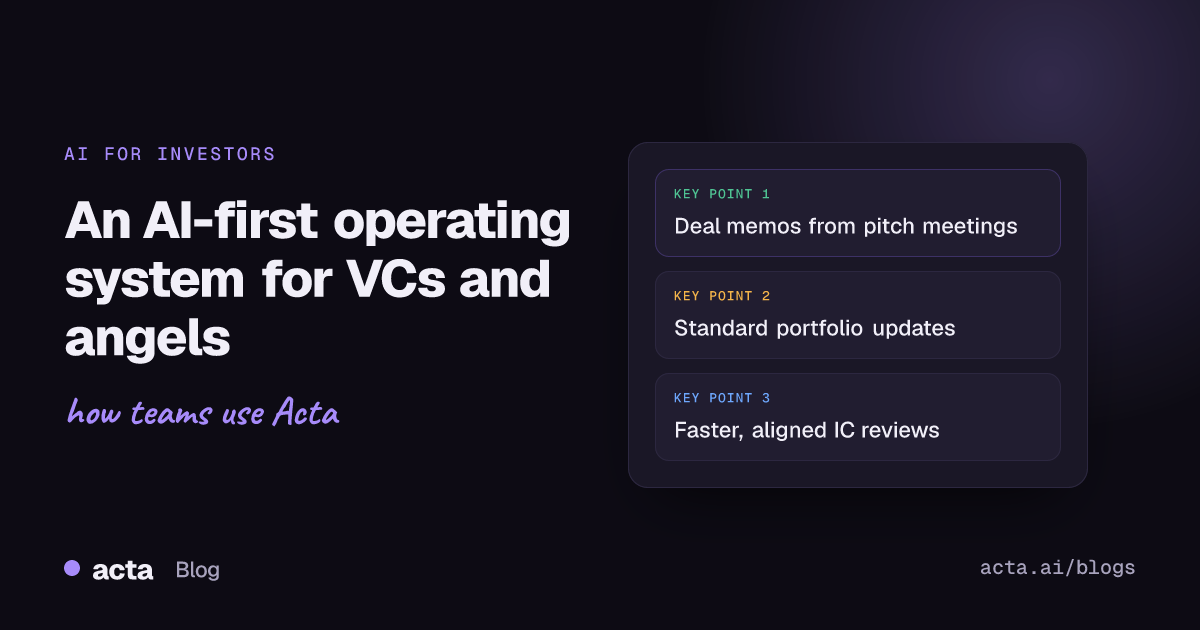
Quick answer: Acta gives venture capital and angel investors two purpose-built AI agents. The Dealflow agent turns pitch meetings into structured investment summaries covering team, market, traction and fundraising. The Monthly Check-ins agent turns portfolio calls into standardized updates on vitals, runway, hiring and red flags. Together they replace manual notes with consistent, shareable intelligence from every meeting.
In venture capital, speed, clarity and insight drive performance. Yet the day-to-day workflow is often slowed down by manual notes, scattered insights, inconsistent founder updates and time-consuming deal analysis.
At Acta, we are tackling this with purpose-built AI agents that work like virtual investment analysts: they capture, organize and deliver structured, actionable intelligence from your meetings.
Why is time the bottleneck for VCs?
Investors sit through dozens of meetings every week, from early-stage pitches to monthly portfolio check-ins. Critical investment signals get buried in dense conversations or lost in scattered notes. By the time partners regroup, key context may already be stale, incomplete or forgotten.
That leads to familiar problems:
- Slow deal processing because notes are not standardized
- Misalignment at Investment Committee (IC) because summaries are inconsistent
- Missed follow-ups with high-potential startups
- Time lost transcribing or re-listening to meetings
- Poor visibility into the real-time health of the portfolio
We have written about the cost of this in more detail in the investment associate gap and the memo tax.
How do Acta's VC agents work?
Acta records your meetings on Zoom, Google Meet or Microsoft Teams, or from an uploaded recording, and the agents then turn each conversation into the format an investor actually needs. There are two agents, each built for a different part of the investment cycle.
Agent 1: VC Assistant – Dealflow
Goal: generate investment summaries from dealflow meetings.
The Dealflow agent works from your pitch meetings and produces clear, investor-grade reports. Each summary covers:
- Company overview
- Founding team experience
- Problem and solution fit
- Product differentiators
- Market size and competition
- Traction metrics and fundraising status
You also get a high-level TL;DR, with the option to drill into each section. That makes it easy to share with partners or prepare for IC reviews.
Investor benefit: no more scrubbing through recordings or flipping between Notion, docs and Slack. You have a structured deal memo on day one, ready to review, compare and act on.
Agent 2: VC Assistant – Monthly Check-ins
Goal: create concise, standardized updates from portfolio check-in meetings.
This agent turns raw founder updates into crisp summaries you can compare across companies and months. It extracts:
- Company vitals
- Technology and product progress
- Team and hiring updates
- Financial health and runway
- Business growth metrics
Every update follows the same structure, summary first with drill-down available, and lists the participants, new opportunities and red flags so nothing gets lost between calls.
Investor benefit: stay in sync with your portfolio without chasing decks or scheduling extra follow-ups. The summaries slot straight into fund reporting, board prep and LP updates.
What makes these agents fit the VC workflow?
Acta agents are not just note-takers. They are context-aware AI co-pilots built with the nuances of venture work in mind. They help you:
- Move faster on deals
- Standardize IC documentation
- Make sure no follow-up or founder update is missed
- Spot portfolio risk, or upside, early
- Share insights across the team without extra effort
Because every meeting is captured in one place, you can also ask questions across all your meetings, for example what a founder said about runway last quarter, and get answers with sources.
Why use AI agents for venture capital now?
AI has reached the point where domain-specific agents can genuinely support knowledge work. Venture capital, where signal density is high but documentation is thin, is a natural fit.
Acta's agents turn every meeting into structured intelligence, so you and your team can focus on strategic thinking rather than transcription.
What's next for investors using Acta?
Acta already supports investors who want to scale dealflow diligence and improve portfolio visibility without adding headcount. If you want to move faster, stay sharper and avoid missing the next breakout company, the VC agents are built for you. See more on how Acta works for investors and VCs, or talk to our team about bringing Acta agents into your fund's workflow.
Frequently asked questions
What does the Acta Dealflow agent produce?
It turns a pitch meeting into a structured investment summary with a TL;DR and sections on the company, founding team, problem and solution fit, differentiators, market and competition, and traction and fundraising status.
How does Acta help with portfolio check-ins?
The Monthly Check-ins agent converts founder calls into standardized updates covering company vitals, product progress, hiring, financial health and runway, and growth metrics, with participants, new opportunities and red flags called out.
Can the summaries be used for IC reviews and LP updates?
Yes. The consistent structure makes deal memos easy to compare before Investment Committee, and check-in summaries fit into fund reporting, board prep and LP updates.
Do the agents work for angel investors as well as VC funds?
Yes. Any investor who takes pitch meetings or runs regular portfolio calls can use the same agents to keep notes structured and comparable.
Smarter investing starts with smarter meetings: try Acta free for 15 days.